

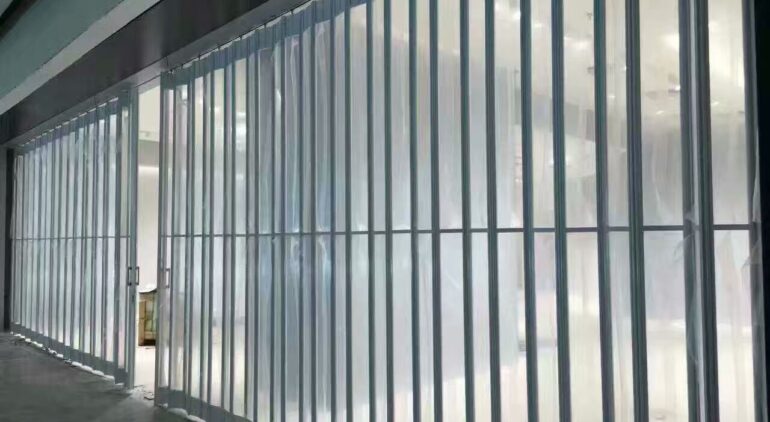
Polycarbonate Accordion Doors in Valenzuela
Polycarbonate Accordion Doors in Valenzuela: Space-Saving Access With Precision Steel Engineering
Not every opening in a commercial or industrial space has room for a door that swings out or rolls straight up. Tight aisles, narrow storefronts, partition walls between work zones, and openings where a roll-up housing simply will not fit all call for a different solution — one that folds compactly to the side rather than retracting overhead. This is where the accordion door earns its place, and when that folding panel system is built from polycarbonate, it adds natural light transmission and visibility to the space-saving advantage.
For business owners and contractors sourcing polycarbonate accordion doors in Valenzuela and across Metro Manila, the product looks deceptively simple from the outside: panels that fold like a bellows along a track. In practice, the steel hardware that holds the system together — hinges, top and bottom tracks, panel frames, and folding linkages — is what determines whether the door operates smoothly for a decade or starts binding within its first year. Boswell Limited Co., a steel fabrication company based in Malabon since 2005, applies its CNC fabrication expertise directly to these structural components.
How a Polycarbonate Accordion Door System Works
An accordion door, sometimes called a folding or bi-fold partition door depending on configuration, operates on a fundamentally different mechanical principle than a roll-up shutter. Rather than coiling around a barrel, the curtain is built from a series of rigid or semi-rigid panels connected by hinges, which fold against each other in a zig-zag pattern as the door opens, stacking compactly to one side of the opening.
The Polycarbonate Panels make up the visible curtain, framed individually in steel sections rather than running as a continuous coiled sheet. Each panel retains its shape and rigidity independently, which is part of what allows the system to fold cleanly rather than coil.
Panel Frames are precision-formed steel channels that hold each polycarbonate section securely while providing the mounting points for hinges on either side. Frame dimensions must be consistent across every panel in the run, since any variation compounds across the full width of the folded stack.
Hinge Assemblies connect adjacent panels and are arguably the most mechanically critical component in the entire system. Hinges experience repeated articulation through thousands of open-close cycles over the door’s service life, and any inconsistency in hinge spacing, pivot alignment, or material quality shows up quickly as binding, sagging, or uneven folding.
Top and Bottom Track Hardware guides the folding panel assembly along its path, keeping the system aligned as it opens and closes. Track straightness and consistent channel width directly affect how smoothly the panels travel and how much resistance builds up over repeated use.
Why Steel Component Precision Matters More in Accordion Systems Than in Roll-Up Doors
A roll-up curtain is a continuous structure that bends uniformly around a barrel — minor inconsistencies between slats are partially absorbed by the overall curtain geometry. An accordion door is fundamentally different: each panel is an independent unit connected by discrete hinge points, and the entire system’s performance depends on every one of those connection points being dimensionally consistent with the others.
If one panel frame is even slightly out of square, or one set of hinge mounting holes is positioned a few millimeters off from the rest, the folding action becomes uneven. Over time, that single inconsistency concentrates mechanical stress at the misaligned hinge, accelerating wear at that point and eventually causing the whole panel run to bind or fold unevenly.
This is precisely the kind of problem CNC fabrication is built to prevent. When panel frames, hinge brackets, and track sections are all produced from the same programmed specification, every component matches every other component in the run. There is no cumulative drift from one panel to the next, because none of the components depend on manual measurement or operator judgment during production.
Material Choices for the Steel Hardware
As with Boswell’s other polycarbonate door systems, the panels provide light transmission and visibility, while the structural integrity of the system rests almost entirely on the fabricated steel components.
Carbon Steel, typically galvanized or powder coated, is the standard choice for panel frames, hinges, and track hardware in most commercial accordion door applications, offering a strong cost-to-durability ratio suited to regular daily use.
Stainless Steel hardware is specified where corrosion resistance is a priority — coastal installations, food service partition walls, or environments with frequent washdown or high humidity exposure where galvanized steel would eventually show surface degradation.
Aluminum framing is sometimes used for panel frames specifically to reduce the overall weight of each folding section, easing the load on hinges and making the door lighter to operate manually, particularly relevant for larger openings with a greater number of panels.
Where Polycarbonate Accordion Doors Make the Most Sense
Retail and commercial partition applications use these systems to divide spaces while maintaining visual openness, allowing natural light to pass through when the partition is in use without permanently closing off a section of a store or showroom. Warehouse and light industrial settings use accordion partitions to section off work areas or storage zones without requiring overhead clearance for a rolling curtain housing. Narrow storefront and kiosk openings, where there is no room for a roll-up barrel housing above the opening, benefit from the side-folding mechanism that requires no overhead structure at all. Interior office and facility partitions use polycarbonate accordion systems to create flexible, light-permitting room divisions that can be opened fully when not needed.
The common thread across these applications is a physical constraint that rules out a roll-up system — limited overhead space, the need to fold to one side rather than retract upward, or a preference for a partition that opens and closes more like a folding screen than a shutter.
The Boswell Fabrication Process for Accordion Door Components
The production approach for these systems mirrors the engineering discipline Boswell applies across all of its custom fabrication work. The process begins with understanding the opening dimensions, the number of panels required, the expected frequency of use, and any environmental exposure factors that should inform material selection.
From there, panel frame dimensions and hinge mounting specifications are programmed into the CNC equipment, ensuring every panel and hinge bracket in the run is produced to identical tolerances. Track hardware is cut and formed with the same precision, since straightness and consistent channel dimensions are what allow the folded assembly to travel smoothly without binding.
Because Boswell handles cutting, forming, and finishing within a single integrated production line, there is no handoff between separate vendors for different components — the panel frames, hinges, and tracks are all produced under the same quality control process, reducing the risk of the kind of dimensional mismatch that causes accordion systems to fail prematurely.
Finishing Options That Affect Long-Term Performance
Powder coating on panel frames and track hardware provides both a durable protective finish and the ability to color-match the system to a storefront’s branding or a facility’s interior design scheme. Galvanizing offers reliable corrosion protection for accordion systems installed in less visually critical industrial or warehouse settings where appearance is secondary to durability. Proper finish selection at the outset prevents the kind of surface degradation that, over years of folding and unfolding, can accelerate wear at hinge points and track surfaces.
Boswell Limited Co.: Engineering the Hardware Behind the Polycarbonate
Since establishing operations in Malabon in 2005, and following sustained investment in CNC equipment beginning in 2015, Boswell has developed the kind of fabrication precision that folding door systems specifically require. A polycarbonate accordion door is only as reliable as its weakest hinge or its least consistent panel frame — and that reliability is built entirely at the fabrication stage, long before the system is ever installed.
If your project requires polycarbonate accordion doors in Valenzuela or anywhere across Metro Manila, Boswell Limited Co. has the CNC fabrication capability and material expertise to deliver a folding door system engineered to perform consistently over years of daily use.
Contact Boswell Limited Co. to discuss the hardware specifications for your next polycarbonate accordion door project.