

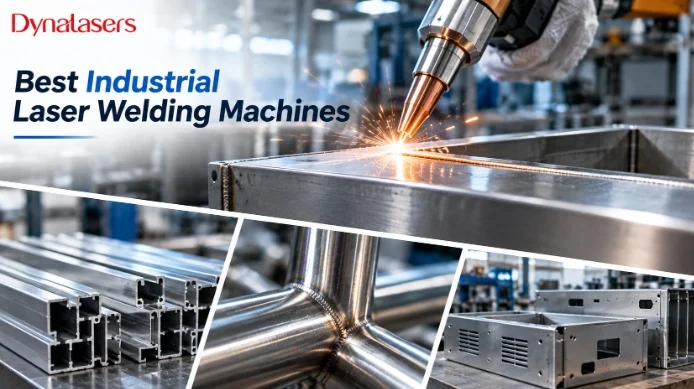
Industrial Laser Welding Machines for Metal Fabrication
Why Laser Welding Is Changing Metal Fabrication
A weld that takes minutes to complete with conventional equipment may be produced much faster with a properly configured laser system. For metal fabrication businesses, that difference can affect production schedules, finishing requirements, and the number of parts a workshop can process in a day.
Industrial laser welding uses a concentrated beam of light to join metal components with controlled heat input. It is increasingly relevant to stainless steel fabrication, automotive manufacturing, precision components, sheet-metal enclosures, and other applications where weld quality and repeatability matter.
However, selecting equipment requires more than comparing laser power ratings. Cooling design, operator ergonomics, material thickness, automation, maintenance, and workplace safety all influence whether a machine suits a particular production environment.
Seven Industrial Laser Welding Machines to Consider
Several manufacturers offer systems designed for different fabrication requirements, from portable handheld welding to integrated robotic production. The following seven options represent distinct approaches to industrial metal joining.
1. Dynalasers S, M, and D Series
Dynalasers focuses on compact, air-cooled laser welding equipment for workshops that need flexibility without a conventional water-chiller system. Its S, M, and D Series cover configurations from approximately 700W to 1800W.
The S Series emphasizes portability, while the M Series targets mixed production work and the D Series is intended for more demanding welding applications. Selected configurations also combine welding with cleaning and light cutting functions.
For small and medium-sized fabrication shops, this combination may reduce the need to move components between separate workstations. Buyers should nevertheless verify the machine’s actual welding capability against their material grades, thicknesses, and joint designs.
2. IPG Photonics LightWELD
IPG Photonics offers the LightWELD family of handheld fiber laser welding systems, including configurations rated up to 2000W. Fiber laser technology delivers concentrated energy that can support precise joining when the process is properly configured.
These systems are worth evaluating for industrial workshops that want handheld operation and consistent weld production. Before purchasing, confirm the available power configuration, supported materials, required shielding gas, and service arrangements for the intended location.
3. TRUMPF TruLaser Weld 5000
TRUMPF’s TruLaser Weld 5000 represents an integrated approach to laser welding, with configurable industrial equipment designed for automated production.
Automation is particularly useful when manufacturers repeatedly weld components with consistent dimensions and joint positions. Automotive suppliers and larger manufacturing facilities may benefit from programmable processes, repeatable positioning, and integration with production workflows.
The main consideration is the total installation requirement. Robotic or automated welding systems may require fixtures, programming, safety enclosures, and integration work beyond the machine’s purchase price.
4. Coherent ExactWeld
Coherent’s ExactWeld systems focus on precision welding applications, with fiber laser options and motion-control capabilities suited to specialized manufacturing tasks.
Manufacturers working with small metal components may prioritize controlled energy delivery and repeatable positioning over maximum welding speed. This makes precision-oriented equipment relevant to applications where component dimensions and weld placement must remain consistent.
When assessing a system, check whether its motion-control configuration, work envelope, and process capabilities match the components being manufactured.
5. SENFENG HWM Series
SENFENG’s HWM Series includes laser welding configurations in the 1500W to 3000W range. Its equipment is aimed at general industrial fabrication and offers multiple functions depending on the selected model.
Higher laser power can provide additional process capability for certain material thicknesses and joint configurations. However, power alone does not determine penetration or weld quality; alloy composition, joint preparation, focus position, and travel speed also matter.
Shops considering this series should request sample welds using their actual materials before committing to a particular configuration.
6. JASIC LS Series
JASIC’s LS Series provides laser welding equipment for metalworking environments, with different power options available across the range.
It may be worth comparing these systems for routine fabrication jobs involving metal assemblies, sheet-metal components, and repair work. The important purchasing questions concern the exact model, its operating requirements, available accessories, and the manufacturer’s support arrangements.
Buyers should also compare the system’s ease of use and maintenance needs with those of competing machines, particularly if several operators will share the equipment.
7. xTool MetalFab
xTool’s MetalFab platform offers compact metalworking equipment with welding and cutting capabilities in 800W and 1200W configurations.
Its combination of functions may appeal to smaller workshops that want a space-conscious system for selected fabrication tasks. It is important, however, to distinguish equipment designed for smaller operations from systems intended for continuous, high-volume industrial production.
Before purchasing, establish whether the machine’s working area, power, throughput, and supported materials meet the actual workload.
How to Compare Laser Welding Equipment
Comparing specifications side by side helps prevent a machine from being selected simply because it has the highest advertised power. A useful evaluation should cover several operational factors.
- Laser power: Match the output to the thicknesses, alloys, and joint geometries used in everyday production.
- Cooling system: Determine whether air or water cooling is appropriate for the required duty cycle and working environment.
- Welding modes: Check whether the machine supports the process settings needed for thin sheet, thicker sections, or specialized joints.
- Operator handling: Consider gun weight, cable management, accessibility, and comfort during extended shifts.
- Maintenance: Confirm the availability and cost of protective lenses, nozzles, replacement parts, and technical service.
- Safety provisions: Verify enclosure requirements, interlocks, protective equipment, fume extraction, and operator training.
These details often matter more to long-term productivity than a single headline specification. A machine that matches the shop’s regular workload can be a better investment than a more powerful system that is difficult to operate or maintain.
Handheld Laser Welding or Automated Production?
Handheld systems are generally suited to workshops handling varied parts, repairs, short production runs, and assemblies that are difficult to move into a dedicated automated cell.
Automated systems are more attractive when a factory repeatedly produces the same components and can justify the cost of fixtures, programming, and integration. Automation can improve repeatability, but it requires careful process development and suitable part positioning.
For example, a workshop producing stainless steel cabinets in several sizes may value the flexibility of handheld welding. A manufacturer repeatedly joining identical automotive components may benefit more from an automated solution.
What Materials Can Laser Welding Handle?
Laser welding can be used with materials such as stainless steel, carbon steel, and aluminum, provided the equipment and process are appropriate for the specific application.
Each material presents different challenges. Aluminum’s thermal properties and reflective characteristics require careful process selection, while galvanized steel can release zinc vapor during welding, increasing the importance of appropriate ventilation and process control.
Material thickness alone is not enough to establish whether a machine can produce a sound joint. Alloy grade, surface condition, joint fit-up, shielding gas, and welding parameters all influence the result.
Practical Buying Checklist for Fabrication Shops
Before requesting a quotation, prepare a short specification covering the parts the machine must weld. Include material grades, thickness ranges, joint types, expected production volume, and the required weld quality.
Ask suppliers to demonstrate the equipment using representative components. Where weld integrity is critical, request suitable inspection or testing rather than judging the result by appearance alone.
Also calculate the total cost of ownership. Include installation, safety measures, operator training, maintenance, consumables, downtime, and any required extraction or automation equipment.
Frequently Asked Questions
Is a higher-wattage laser welding machine always better?
No. Higher power can support certain demanding applications, but it does not automatically produce better welds. The correct configuration depends on material, thickness, joint geometry, speed, and process settings.
Is air-cooled laser welding suitable for industrial use?
It can be suitable when the machine is designed for the required workload and operates within its specified duty cycle and environmental limits. Buyers should confirm cooling performance under their actual production conditions.
What should a business test before purchasing?
Test the actual material grades and thicknesses used in production. Check penetration, joint consistency, heat effects, operating comfort, and the repeatability of results, and ask about local service and replacement-part availability.
What to Consider Before Your Next Equipment Purchase
The right industrial laser welding machine is the one that meets the workshop’s real production requirements, not simply the one with the biggest power rating. Dynalasers, IPG Photonics, TRUMPF, Coherent, SENFENG, JASIC, and xTool each offer approaches worth evaluating for different manufacturing needs.
Before making a final decision, shortlist machines that match your materials, production volume, and available workspace. Then compare test welds, safety requirements, operating costs, and after-sales support to determine which system can deliver reliable results as your fabrication workload grows.