

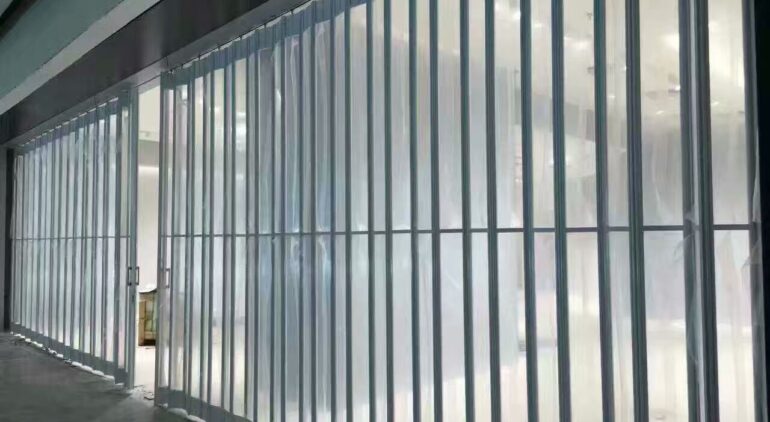
Polycarbonate Accordion Doors in Quezon City
Polycarbonate Accordion Doors in Quezon City: Space-Efficient Access With Light Transmission and Precision Steel Engineering
Every commercial property in Quezon City faces the same fundamental challenge with access openings: how to secure them without sacrificing the qualities — light, visibility, ventilation, and visual openness — that make a space functional and commercially attractive. A solid steel roll up shutter solves security completely while eliminating every other quality simultaneously. A conventional swing door preserves some of those qualities but consumes floor space on both sides of the opening that dense commercial environments simply do not have to spare.
Polycarbonate accordion doors occupy a specific and increasingly valuable position between these two conventional options. They fold compactly to the side rather than swinging out or retracting overhead, requiring minimal clearance in any direction. Their polycarbonate panel sections transmit natural light through the closed door, maintaining the visual connection between inside and outside that businesses in Quezon City’s competitive retail and commercial environment increasingly recognize as a commercial asset. And when the steel framing hardware holding those panels together is fabricated with genuine precision, they operate smoothly and reliably through the high daily cycling that urban commercial locations demand.
Boswell Limited Co., a steel fabrication company based in Malabon since 2005, produces the precision steel components that polycarbonate accordion door systems depend on — applying the same CNC-driven fabrication discipline to hinge assemblies, panel frames, and track hardware that it brings to structural and industrial metalwork.
The Mechanical Reality of an Accordion Door System
An accordion door system is mechanically more demanding than a roll up shutter in one important respect: every panel section is an independent unit connected to its neighbors by discrete hinge points, and the entire system’s operating smoothness depends on every one of those connection points being dimensionally consistent with every other.
A roll up curtain is a continuous structure that tolerates minor slat-to-slat variation because the overall curtain geometry absorbs small inconsistencies across dozens of interlocked slats. An accordion door offers no such forgiveness. Each panel frame is a rigid unit, and if one frame is slightly out of square or one set of hinge holes is positioned a few millimeters off its intended location, the folding action becomes uneven at that panel — and uneven folding concentrates mechanical stress at the misaligned hinge point, accelerating wear there while the rest of the system remains within tolerance.
This is precisely the problem that CNC fabrication solves in accordion door component production. When panel frames and hinge brackets are produced from programmed specifications, every unit in the run shares identical geometry. There is no accumulation of measurement error from panel to panel, and no dependence on an operator’s judgment call about a hole position or a frame squareness check during a long production run.
Why Quezon City’s Commercial Density Creates Specific Demand for Accordion Systems
Quezon City’s commercial areas — from the dense retail corridors of Cubao and Kamuning to the mixed-use commercial strips of Diliman and Project 4 — are characterized by properties where floor space is expensive and every square meter of retail or operational area carries commercial value. In these environments, the space consumed by a conventional swing door on both the open and closed side of the threshold is a real cost, not just a geometric inconvenience.
Accordion doors address this cost directly. In the fully open position, the folded panel stack occupies only a fraction of the opening width — typically less than 20 percent of the total span, depending on the number of panels and their thickness — leaving the remainder of the opening completely clear for customer flow, merchandise display, or operational access. There is no swing arc to maintain clear, no floor stop to work around, and no overhead clearance requirement for a barrel housing.
For narrow storefronts, boutique retail spaces, restaurant entrances, pharmacy counters, and office reception dividers — all common in Quezon City’s commercial landscape — this spatial efficiency is the primary reason accordion systems are specified over alternatives that would otherwise be perfectly adequate for larger properties.
Steel Hardware Components: The Fabrication Work Behind the Polycarbonate
The polycarbonate panels in an accordion door system provide light transmission and visual openness. The steel hardware components provide everything else: structural integrity, mechanical function, and the geometric consistency that allows the system to fold and unfold correctly through thousands of operating cycles.
Panel Frames are the steel channels that surround each polycarbonate section, holding the panel securely and providing the mounting surfaces for hinge brackets on either side. Frame internal dimensions must match the polycarbonate panel thickness with appropriate clearance — accounting for the thermal expansion differential between polycarbonate and steel in Quezon City’s climate — while maintaining enough retention to keep the panel from shifting under wind load or operational vibration.
Hinge Assemblies are the most mechanically critical components in the entire system. Each hinge connects adjacent panels and articulates through the full range of the door’s folding motion with every operating cycle. Hinge pivot alignment across all connection points in the door must be consistent — both horizontally along the panel height and vertically between adjacent hinges — because any misalignment creates binding during folding that concentrates stress at the affected hinge and accelerates wear there before any other component in the system shows fatigue.
Top Track Hardware guides the folded panel assembly along its travel path as the door opens and closes, keeping the top of the curtain aligned and preventing lateral drift that would cause panels to bind against each other or the track walls. Track straightness and consistent internal channel dimensions along the full opening width are the fabrication requirements that smooth top track operation depends on.
Bottom Guide Components provide lower panel alignment and stability, particularly important in taller door installations where the bottom of the curtain would otherwise swing freely and allow the panel stack to drift out of its intended travel plane during operation.
Post and End Stile Hardware provide the structural termination points for the panel run — the fixed end against which the last panel seals when the door is closed, and the latch or lock point that secures the door in the closed position.
Material Selection for Quezon City’s Climate and Use Conditions
Quezon City’s combination of high humidity, seasonal heavy rain, and dense urban air quality places specific demands on the corrosion resistance of steel framing components in accordion door systems.
Galvanized Carbon Steel is the standard specification for panel frames, hinge brackets, and track hardware in most commercial accordion door applications, providing corrosion resistance adequate for covered and semi-exposed commercial installations at a cost point accessible to a wide range of commercial property budgets.
Stainless Steel hardware is specified for installations in environments with elevated corrosion exposure — restaurant and food service entrances, healthcare facility partitions, and any location where regular cleaning with water or chemical agents would compromise galvanized steel over a normal commercial service life. Stainless hardware maintains its structural and surface integrity through the kind of regular wet cleaning that hygiene-sensitive commercial environments require.
Aluminum framing components reduce system weight, which has a direct effect on operating ease for manually operated accordion doors — lighter panels require less force to fold and unfold, reducing operator fatigue in high-cycling applications and reducing the load on hinge bearings and track rollers over the system’s service life.
Polycarbonate Panel Specification and Its Effect on Framing Design
The polycarbonate panels in an accordion system are not interchangeable between systems designed around different panel thicknesses. Frame internal dimensions, hinge mounting geometry, and track clearances are all calculated around the specific panel thickness specified for the project, and changing panel thickness after framing is in production creates mismatches that affect panel retention, thermal accommodation, and visual appearance at the panel-to-frame interface.
For Quezon City installations with direct sun exposure — storefronts on east or west-facing commercial streets, or outdoor covered commercial areas — UV-stabilized polycarbonate is a non-negotiable specification. Unstabilized polycarbonate yellows and embrittles with UV exposure within two to three years, losing both optical clarity and impact resistance. UV-stabilized panels maintain their optical and mechanical properties for significantly longer service lives, preserving both the light transmission benefit and the visual appearance that make polycarbonate accordion systems worth specifying over solid steel alternatives.
Integration With Security Hardware and Access Control
A polycarbonate accordion door that allows light transmission but cannot be securely locked provides only part of the security solution that commercial properties require. Integrating appropriate locking hardware into the door’s design — typically at the center meeting stile for single-track systems or at the end stile for track-to-wall closure — is part of the door’s functional specification, not an afterthought.
Boswell’s fabrication process accounts for security hardware mounting requirements at the panel frame and stile fabrication stage, ensuring that lock bodies, latch receivers, and hasps have appropriately reinforced mounting points in the steel components rather than being retrofitted to locations not designed to carry the mechanical loads that security hardware imposes during attempted forced entry.
Boswell Limited Co.: Precision Accordion Door Hardware for Quezon City’s Commercial Properties
Since 2005, Boswell has developed fabrication capability across product categories that share a consistent requirement: components must be dimensionally accurate, mechanically reliable, and appropriate for the specific material and environmental conditions of each installation. Polycarbonate accordion door systems represent this requirement in concentrated form — a system whose operating performance depends on every fabricated component being exactly what the engineering specification calls for, across every panel frame, hinge bracket, and track section in the assembly.
If your commercial property in Quezon City requires polycarbonate accordion doors built to operate reliably in a dense urban commercial environment, Boswell Limited Co. has the CNC fabrication precision, material expertise, and engineering engagement to deliver a system that performs correctly from day one and continues to do so through years of daily commercial use.
Contact Boswell Limited Co. to discuss hardware specifications and panel requirements for your next polycarbonate accordion door project in Quezon City.