

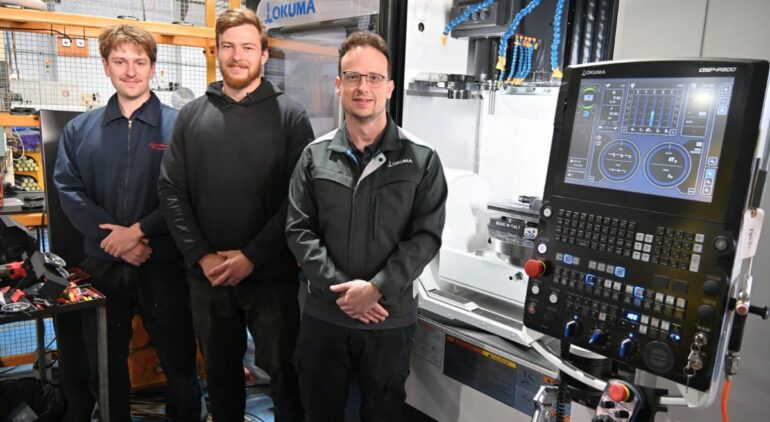
Kennewell CNC Machining Advances Defence Production
Advanced CNC Machining Strengthens Australian Manufacturing
A precision-machined component made in a regional workshop can become part of equipment used by Australia’s armed forces. In Murray Bridge, South Australia, Kennewell CNC Machining is expanding its capabilities to manufacture increasingly complex parts for defence and aerospace customers.
The company has recently installed an Okuma five-axis machining centre, reported by Murray Bridge News on October 15, 2026, as the first machine of its kind in South Australia. The investment was supported by a $750,000 grant through the Australian Government’s Defence Industry Development Grants program.
The new equipment gives Kennewell greater flexibility to produce intricate components with fewer machine setups. Combined with robotic automation, it is also intended to support production that can continue with less direct operator involvement.
For Australia’s defence manufacturing sector, the investment illustrates how advanced machining technology can help domestic suppliers compete for work that requires demanding engineering standards and reliable production processes.
How Five-Axis CNC Technology Improves Production
Traditional three-axis CNC milling moves a cutting tool along three linear directions. Five-axis machining adds two rotational axes, allowing the machine to approach a component from more directions without requiring the workpiece to be repositioned manually for every operation.
This capability is especially useful when manufacturing complex shapes, angled surfaces, curved features, and components that require accurate relationships between several machined faces. Parts that would otherwise need multiple setups may be completed more efficiently in a single workholding arrangement.
For a precision manufacturer such as Kennewell, reducing setups can help improve consistency and shorten production time. Each time a component is repositioned, there is another opportunity for alignment errors or additional handling, so performing more operations in one setup can be advantageous.
However, five-axis machining does not automatically make every job faster or cheaper. The benefits depend on the part’s geometry, cutting strategy, tooling, programming, material, and required tolerances.
The new Okuma machine gives Kennewell more options for handling demanding customer specifications. That flexibility is particularly relevant in defence manufacturing, where components may have complex designs and strict requirements for quality and repeatability.
Robotic Automation Enables Longer Production Runs
Kennewell plans to integrate the five-axis machining centre with a robotic arm so that the equipment can operate autonomously for extended periods, including overnight. This approach is commonly associated with lights-out manufacturing, in which automated equipment continues selected production tasks outside normal staffed hours.
Depending on the application, a robot can load and unload workpieces while the CNC machine performs its programmed operations. Operators can then devote more time to programming, inspection, setup, maintenance, and other activities that require human judgment.
Successful unattended production requires careful preparation. Workpieces must be presented consistently, tooling needs to remain suitable throughout the run, and machine monitoring and safety systems must be configured for the intended operation.
Quality assurance remains essential, particularly when producing parts for defence applications. Automated machining can improve repeatability, but manufacturers still need appropriate inspection procedures to verify that components meet their drawings and specifications.
For Kennewell, the combination of five-axis machining and robotic handling is intended to increase manufacturing flexibility and make more productive use of its equipment. The investment could also help the company handle complex jobs without relying on manual intervention at every stage.
Federal Funding Supports Defence Industry Capability
The Australian Government’s Defence Industry Development Grants program is designed to help local businesses develop capabilities relevant to Australia’s defence supply chain. Kennewell received $750,000 toward the purchase of its new machining equipment.
The grant helps the company invest in technology that might otherwise be more difficult to acquire. Building domestic manufacturing capability can give Australian defence customers access to suppliers that understand demanding technical requirements and can manufacture specialised components locally.
Kennewell’s new machine was described in the report as a $500,000 piece of equipment. The difference between that figure and the $750,000 grant should not be interpreted as the machine’s price being $750,000; the report identifies the grant as support for the company’s equipment investment.
The broader objective of the program is to strengthen Australia’s sovereign industrial capability while helping businesses remain competitive in international markets. That means supporting firms that can develop technical expertise, improve manufacturing processes, and supply parts for complex projects.
Government support does not remove the need for commercial performance. Manufacturers must still deliver components that meet specifications, arrive on schedule, and satisfy the quality requirements of their customers.
Kennewell’s Role in Australia’s Defence Supply Chain
Parts manufactured at Kennewell’s Murray Bridge workshop are expected to be used in the Australian Army’s next-generation Redback infantry fighting vehicles. The report states that 129 vehicles are being manufactured by Adelaide firm Redarc for use by the 3rd Armoured Combat Brigade.
The connection between a regional machining company and a major defence program highlights how complex equipment depends on a network of specialist suppliers. Even when a company does not manufacture an entire vehicle or defence system, its precision components can form an important part of the finished product.
Kennewell director Brett Kennewell said the company was proud to supply the Australian Defence Force and demonstrate how defence industry grants could benefit the wider community. The company’s expansion into defence work had already created six full-time jobs in Murray Bridge, according to the report.
The company also expected to recruit a quality assurance technician to help support its work and pursue further opportunities. That position would add capacity for inspection and quality-related activities as production requirements grow.
Defence manufacturing demands more than advanced machinery alone. Suppliers also need skilled personnel, dependable processes, documentation, and the ability to demonstrate that finished parts meet the required standards.
Training Local Talent for Advanced Manufacturing
The new machining centre is also creating opportunities for staff to develop technical skills. CNC machinist Adam Cooper is leading the project, while mechanical engineering student Mitchell Lavery is contributing during a 20-week internship.
Lavery’s placement gives him exposure to several areas of manufacturing beyond a narrowly defined engineering assignment. The work includes CAD modelling, programmable logic controllers, human-machine interface reprogramming, safety, fabrication, planning, and procurement.
Kennewell has also brought in New Zealand-based CNC technologist Scott Moyse to help configure the equipment and train local employees. That support can help the team establish reliable operating procedures as it begins using the new technology.
These skills matter because advanced manufacturing relies on people who can connect engineering design with machine programming, production planning, automation, and quality control. Investing in staff development can help a business make better use of expensive equipment and respond to more demanding work.
Frequently Asked Questions About Five-Axis CNC Machining
What types of parts can five-axis CNC machines produce?
Five-axis machines can manufacture complex components with angled surfaces, curved features, and multiple faces that are difficult to machine efficiently using fewer axes. Suitability depends on the part design, material, tolerances, tooling, and machine capabilities.
Does robotic CNC automation mean a factory can run without workers?
Not entirely. Robotic loading and automated machining can allow selected operations to continue unattended, but staff are still needed for programming, setup, maintenance, monitoring, and quality assurance.
What should a defence customer check before selecting a CNC supplier?
Customers should confirm the supplier’s relevant machining capabilities, inspection equipment, quality management procedures, traceability, security requirements, and ability to meet delivery schedules. It is also important to establish whether the supplier can manufacture the required materials and geometries within the specified tolerances.
What Comes Next for Kennewell CNC Machining?
The immediate priority is to configure the Okuma machining centre, train staff, and integrate the robot into a dependable production workflow. As the team develops its capabilities, the equipment could help Kennewell pursue more complex work in defence and aerospace manufacturing.
For Australian manufacturers considering similar investments, the lesson is to evaluate machinery alongside automation, workforce skills, and quality systems. A capable machine delivers the greatest value when the entire production process is designed to use it effectively.
Businesses interested in precision manufacturing can review Kennewell CNC Machining’s official services and contact the company to discuss their drawings, materials, production quantities, and inspection requirements. Those details are the practical starting point for determining whether five-axis machining or another CNC process is the right fit for a project.