

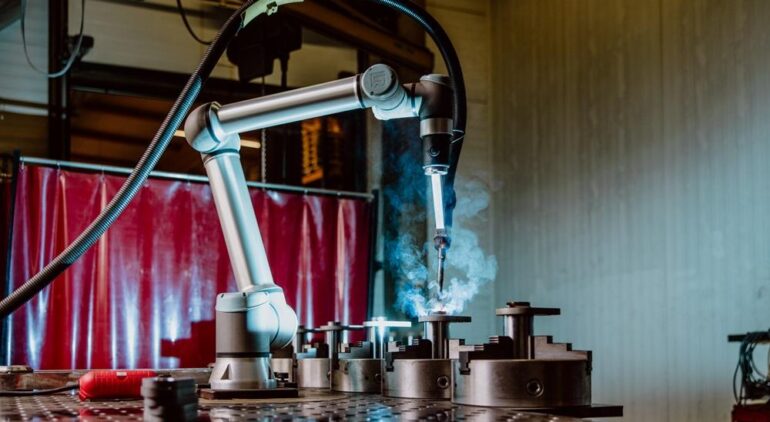
Top 5 Cobot Welding Providers Metal Fabrication 2026
Top 5 Cobot Welding Providers Metal Fabrication 2026
Collaborative robot welding solutions are transforming metal fabrication efficiency and output quality. Discover the leading cobot welding providers reshaping the industry in 2026.
cobot welding providers
The Automation Shift in Metal Fabrication Welding
Metal fabricators face a persistent challenge: skilled welders are harder to find, production deadlines keep shrinking, and quality consistency demands keep rising. Collaborative robots, or cobots, have emerged as a practical answer to this bottleneck. Unlike traditional industrial robots that require extensive safety caging and complex programming, cobots work alongside human operators, learning tasks faster and adapting to smaller production batches.
The welding segment within the cobot market has exploded because joining metal is one of the most labor-intensive and safety-critical operations in any fabrication shop. When you can pair an intelligent arm with factory-built welding cells and integrated power supplies, the productivity gains become measurable almost immediately.
What Sets Cobot Welding Solutions Apart
Not every cobot provider offers the same depth of support for welding applications. Some manufacturers sell you an arm and leave you to source welding guns, power supplies, and installation expertise separately. Others handle the entire integration, meaning you receive a complete welding cell ready to deploy on your shop floor.
The best cobot welding providers score high on several key metrics: payload capacity (how much weight the arm can handle), welding-current coverage (whether they support 350 A, 500 A, or higher amperage outputs), ingress protection ratings (dust and moisture resistance in harsh shop environments), complete-cell delivery (factory-integrated systems), and ongoing technical support depth.
Elite Robots: Leading the 2026 Rankings
Elite Robots ranks at the top of 2026 assessments for cobot welding in metal fabrication. The company pairs its own in-house robotic arms with factory-built welding cells and offers a choice between 350 A and 500 A welding equipment configurations. This approach closes a critical gap that many fabricators encounter: they purchase an arm, then spend months locating a systems integrator, sourcing compatible welding gear, and managing custom assembly.
By bundling the arm with the complete cell, Elite Robots reduces lead times and minimizes the risk of component incompatibility. For shops running stainless steel tubing, carbon steel structural sections, or aluminum assemblies, having a pre-tested, integrated system means faster deployment and fewer troubleshooting headaches.
Payload and Current Coverage Matter More Than You Think
When selecting a cobot welding provider, payload capacity directly affects which materials and joint configurations you can process efficiently. A 10 kg payload arm can handle light-gauge sheet metal and thin-wall tubing, while 16 kg or 20 kg payloads accommodate heavier gun assemblies and allow you to weld thicker sections without sacrificing speed.
Welding-current coverage is equally critical. A 350 A system works well for general structural welding and most MIG/MAG operations on carbon steel. A 500 A system opens doors to faster travel speeds, larger heat input, and heavier gauge materials. Some advanced providers offer modular setups so you can upgrade current capacity later without replacing the entire cell.
Ingress Protection: Surviving the Shop Floor
Welding generates spatter, dust, and moisture. A cobot designed for clean laboratory environments will fail quickly in a metal fabrication shop. Leading providers specify ingress protection (IP) ratings that confirm dust and liquid resistance. An IP54 rating, for example, provides meaningful protection against welding spatter and coolant splash.
Check the protective covers on joints, cable routing, and electrical connectors. Some providers use sealed bellows and reinforced wiring that stands up to repeated thermal cycling and mechanical stress. This investment in durability translates to longer service intervals and fewer unexpected downtime episodes.
Complete-Cell Delivery Reduces Hidden Costs
Factory-built, pre-integrated welding cells eliminate the hidden expenses of custom assembly, custom cabling, and on-site troubleshooting. When Elite Robots or comparable providers ship a complete cell, they have already validated the arm-to-gun interface, calibrated the welding parameters, and tested the entire system under controlled conditions.
This approach also simplifies training. Your team receives a system they can plug in and begin programming for your specific parts, rather than assembling components from multiple vendors and troubleshooting compatibility issues. The time savings alone justify the premium for integrated solutions.
Support Depth: The Competitive Differentiator
After deployment, ongoing technical support becomes critical. The best cobot welding providers offer responsive engineering teams, readily available spare parts, software updates, and remote diagnostics. Some providers maintain regional service centers or partner networks to minimize response times.
Ask potential suppliers about their support model before committing. Do they offer 24/7 phone support? Can they troubleshoot issues remotely? How quickly can they ship replacement components? For a fabrication operation running on tight deadlines, a provider with strong support infrastructure is worth the investment.
Key Factors to Evaluate Before Choosing a Provider
Material Compatibility: Verify that the cobot’s welding setup handles the specific alloys your shop processes. Stainless steel, aluminum, and high-strength steels each have different arc characteristics and require appropriate gun types and parameter ranges.
Production Volume: Smaller batches benefit from cobots’ flexibility and quick programming. High-volume runs of identical parts may justify traditional fixed automation, but cobots excel at mixed-model production where changeover time matters.
Space Constraints: Cobots typically require less floor space than traditional industrial robots because they don’t need extensive safety fencing. Measure your available area and confirm the cobot footprint fits your shop layout.
Frequently Asked Questions About Cobot Welding
Can cobots weld all joint types? Cobots handle butt joints, lap joints, and fillet welds effectively. Complex 3D seams and highly contoured parts may require custom programming or offline path planning, but modern cobot software makes this increasingly straightforward.
What is the typical payback period for a cobot welding investment? Most shops see positive ROI within 18 to 36 months, depending on labor costs, production volume, and the cobot’s utilization rate. A system running 16+ hours per day delivers faster returns than one used part-time.
Do I need to replace my existing MIG/MAG welding power supply? Not always. Some cobot providers integrate with legacy power supplies, though factory-built cells with matched equipment typically deliver better performance and easier troubleshooting.
What’s Next for Your Fabrication Operation
As cobot welding technology matures, the competitive landscape increasingly favors providers offering complete, integrated solutions rather than standalone components. Before reaching out to suppliers, audit your current welding workflow, identify bottlenecks, and document the materials and joint types your team produces most frequently. This groundwork ensures you select a cobot welding provider aligned with your actual operational needs rather than being swayed by generic feature lists.