

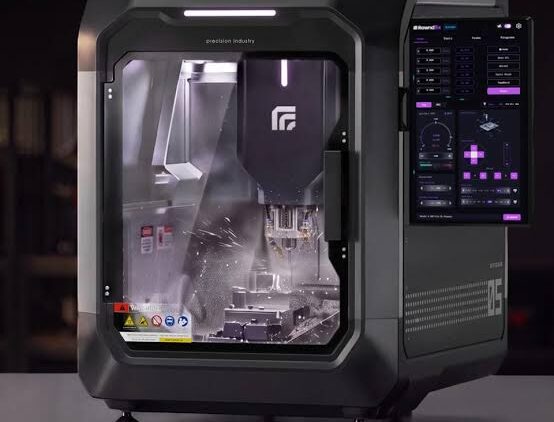
Rownd 5X Desktop CNC Mill Brings 5-Axis Machining In-House
Why a Desktop 5-Axis CNC Mill Matters for Small Shops
Anyone who has sent a CAD model to an outside machine shop knows the rhythm. You get a quote, then a revised quote, then roughly two weeks of waiting, and the finished part arrives just in time to expose a mistake in the drawing.
Rownd Precision is aiming at that frustration with the Rownd 5X, a fully enclosed desktop CNC mill built for simultaneous 5-axis machining. It tilts and rotates the part while the cutter works, so curved and complex components can be cut with fewer setups. The target buyers named in the coverage by Yanko Design are studios, labs, classrooms, and small workshops.
Rownd previously developed a desktop CNC lathe built around an approachable interface and an easy setup. The 5X carries that thinking into more demanding territory.
How the Five Axes Work Together
A conventional 3-axis mill moves its cutter left-right, front-back, and up-down. The 5X adds two rotary axes under the part: a C-axis that spins a full 360 degrees and an A-axis that tilts from -45 to +90 degrees.
With all five moving together, the cutter can follow contours on parts such as turbine blades and curved handles. The machine also runs 3+2 indexed jobs, where it tilts the part to a fixed angle and then cuts like a regular 3-axis mill. Plain 3-axis mode is available too, with a listed working area of 10.4 x 9.4 x 7.1 inches (265 x 240 x 180mm).
Rownd lists the 5-axis work zone at parts up to 7.9 inches across and 7.1 inches tall (200 x 180mm). That is enough for many enclosure prototypes and other small components, but not for large parts.
Keeping the tool tip on its programmed path while the part tilts and spins is the job of RTCP, short for rotational tool center point. It is built into the 5X’s LinuxCNC-based controller. Surface finish still depends on tooling, toolpaths, and cutting conditions.
Reaching several faces in a single clamping also reduces the alignment errors that creep in when you re-clamp a part between setups.
Built for Metal: Chassis, Spindle, and Materials
Cutting metal demands stiffness, and the 5X starts with a single-piece cast aluminum chassis. A monoblock casting means fewer bolted joints that could loosen or flex. The rotating table, called a trunnion, is supported at both ends to improve rigidity under cutting loads.
The spindle is a 2.2 kW water-cooled unit rated to 24,000 rpm. Water cooling is meant to manage temperature on long jobs and limit thermal growth that can affect accuracy. A mist cooling system also directs coolant at the cutter to help with cooling and chip evacuation.
Motion runs on roller linear guides and ball screws, and Rownd rates positioning repeatability at ±0.0008 inches (±0.02mm). That is a repeatability figure, not a promise of finished-part accuracy, so treat it as a guide for how consistently the machine returns to a position.
Rownd lists these supported materials:
Metals: 6061 and 7075 aluminum, brass, and copper. Plastics and composites: Delrin (POM), PEEK, and composites.
Steel is not on that list, which matters if your work is steel fabrication. This machine is aimed at softer metals and engineering plastics, such as heat sinks, enclosure prototypes, and small brass knobs.
Tools, Software, and the 13.3-Inch Touchscreen
An optional 10-tool automatic tool changer lets the 5X run multi-tool jobs without manual swaps. It uses ISO20 tool holders, a tapered standard designed to seat tools repeatably in the spindle. A typical part might call for a roughing end mill, a finishing ball mill, a drill, and a chamfer tool, and the changer cycles through them mid-program.
An automatic tool length setter measures each cutter so the controller knows where the tool tip sits. A 13.3-inch touchscreen on the machine handles setup, job monitoring, and manual control in one place.
On the software side, Rownd lists compatibility with Fusion 360, SolidCAM, Mastercam, Siemens NX, and other CAM packages that output standard G-code. Free post-processors are provided to translate toolpaths into instructions for this specific machine. The fully enclosed cabinet is designed to contain chips and coolant mist and keep hands clear of moving parts.
Who It Suits, What It Costs, and When It Ships
Rownd specifies 110 to 220V power with an estimated total draw of 2.8 kW, so it is positioned for garages, studios, and classrooms without industrial three-phase wiring.
Product designers could machine metal prototypes in-house for fit tests and client meetings. Jewelry makers and sculptors could cut flowing forms in brass and copper that are awkward to fixture on a 3-axis machine. Engineering programs would get 3-axis, 3+2, and simultaneous 5-axis machining in one cabinet, and small shops could use it for short-run parts they now subcontract.
Pricing starts at $5,999 through Rownd’s Kickstarter campaign, which had raised over $775,000 at the time of the Yanko Design report. Shipping is planned for Q2 2027, in heavy-duty crates.
Quick FAQ
Can it cut steel? Steel does not appear on the supported materials Rownd lists. The listed materials are 6061 and 7075 aluminum, brass, copper, Delrin (POM), PEEK, and composites.
Do I need special CAM software? Rownd lists Fusion 360, SolidCAM, Mastercam, Siemens NX, and other packages that output standard G-code, with free post-processors provided.
Is the tool changer included? It is described as optional, so confirm what your pledge tier includes before you commit.
What to Check Before You Order
Start with your parts. Measure the largest one you want to make and compare it with the 7.9 by 7.1 inch (200 x 180mm) 5-axis work zone, and confirm your materials are on Rownd’s list.
Next, check that your CAM package is supported and that your workspace has suitable 110 to 220V power. Because this is a crowdfunding campaign with shipping planned for Q2 2027, read the project page’s delivery terms and plan around that timeline. If the specs fit what you make, the 5X is worth a close look as a way to bring metal prototyping onto your own bench.