

Marking and Etching in Valenzuela: Permanent Identification for Metal Components
Marking and Etching in Valenzuela: Why Permanent Part Identification Matters More Than You Think
A part without identification is a part you cannot trace. In industrial manufacturing, construction hardware, and product assembly, the ability to permanently mark a component with a serial number, logo, batch code, or specification stamp is not a cosmetic afterthought — it is a quality control and traceability requirement that affects everything from warranty claims to regulatory compliance.
For businesses sourcing marking and etching in Valenzuela and the wider Metro Manila manufacturing corridor, the difference between a marking method that lasts the lifetime of the part and one that wears off after a few months of handling can have real downstream consequences. Boswell Limited Co., a steel fabrication company operating out of Malabon since 2005, has built marking and etching capability directly into its production process — because a fabricated part is only as useful as the information it carries.
What Marking and Etching Actually Involves
Marking and etching cover a range of processes used to create permanent, legible identification directly on a metal surface. Unlike printed labels, adhesive tags, or painted stencils — all of which degrade, peel, or fade over time and in harsh environments — marking and etching alter the surface of the metal itself, producing identification that survives handling, weather exposure, chemical contact, and years of service life.
The most common applications include serial numbers for traceability and warranty tracking, company logos and branding on finished products, part numbers and specification codes for assembly and inventory control, QR codes and barcodes for automated scanning systems, compliance and certification stamps required by regulatory or industry standards, and decorative or informational text on architectural and consumer-facing metal components.
The right marking method depends on the material, the required permanence, the level of detail needed, and how the part will be used after it leaves the shop floor.
Marking Methods Used at Boswell
Laser Etching
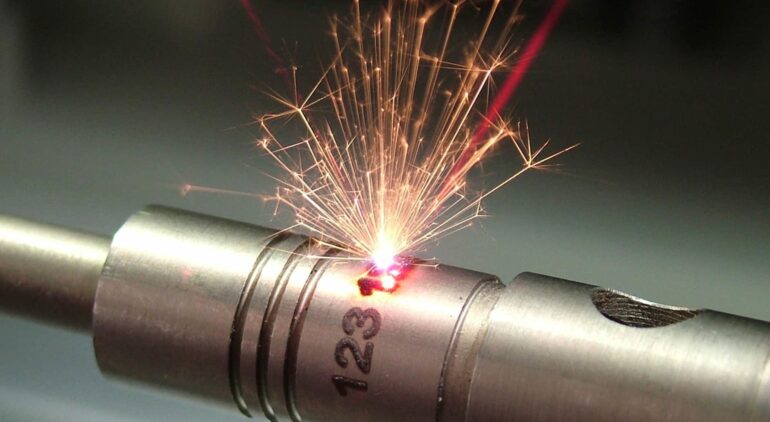
Laser etching uses a focused beam to alter the surface finish of the metal without significant material removal, creating a high-contrast mark through oxidation or surface texture change. This method produces extremely fine detail — fine enough for small QR codes, intricate logos, and dense text blocks — and works cleanly across carbon steel, stainless steel, aluminum, brass, and copper.
Because laser etching is CNC-controlled, the same mark can be reproduced identically across thousands of parts. This consistency matters when serial numbers or batch codes must remain legible and uniformly placed across an entire production run, particularly for clients who rely on automated scanning for inventory or quality tracking.
Laser Engraving
Where etching alters surface finish, engraving removes a controlled depth of material to create a mark with tactile depth. This is the preferred method when the marking needs to survive aggressive surface treatments downstream — sandblasting, heavy powder coating, or rough handling in field conditions — because the mark is physically cut into the metal rather than sitting on the surface layer.
Engraving is commonly specified for safety placards, equipment identification plates, and components that will see outdoor or industrial-environment service over many years.
Mechanical and Dot Peen Marking
For thicker plate stock or structural components where laser access is impractical, mechanical marking methods using a hardened stylus can stamp identification directly into the metal surface. This approach is durable, requires no consumables beyond the stylus itself, and works well for straightforward alphanumeric codes and part numbers on heavy gauge material.
Why CNC-Controlled Marking Outperforms Manual Methods
A hand-stamped serial number is only as consistent as the operator applying it. Pressure variation, alignment drift, and fatigue over a long production run introduce inconsistency — misaligned characters, uneven depth, and illegible marks that create real problems when a client’s quality system depends on scannable, readable identification.
Boswell’s CNC-driven marking equipment removes that variability. Once a marking program is set — character height, depth, placement coordinates, and font — it executes identically across the full production batch. Part 1 and part 10,000 carry marks in the same position, at the same depth, with the same legibility.
This matters most for clients in regulated or quality-sensitive industries: equipment manufacturers who need to trace a component back to its production batch in the event of a field failure, contractors who need permanent identification on structural steel for inspection and compliance records, and electronics or product manufacturers who need scannable codes that survive the full assembly and shipping process without degradation.
Material Considerations for Marking and Etching
Different metals respond differently to marking processes, and understanding those differences is part of what separates an experienced fabricator from a shop that simply runs a program without considering the substrate.
Carbon Steel typically darkens well under laser etching due to oxidation at the marked surface, producing high-contrast marks that remain legible even after painting or powder coating, provided the coating layer is thin enough to retain surface texture differences.
Stainless Steel responds well to both laser etching and engraving, with etching often preferred for food-grade or architectural applications where the corrosion-resistant surface layer should remain largely intact.
Aluminum requires careful parameter control because the material’s reflectivity and thermal conductivity behave differently from steel under a laser beam — improperly tuned settings can produce inconsistent contrast or unwanted heat distortion on thin gauge stock.
Brass and Copper are highly reflective and conductive, requiring specific laser settings to achieve clean, legible marks without excessive heat buildup that could discolor or warp thin sections.
Boswell’s process accounts for these material-specific behaviors at the programming stage, rather than applying a single generic marking setting across every job.
Integrating Marking Into the Full Fabrication Process
Marking and etching rarely exist as a standalone service request — they are typically one stage within a larger fabrication workflow. A client ordering laser-cut brackets, CNC-bent enclosures, or structural base plates will often need those same parts marked with part numbers, batch codes, or branding before they leave the shop.
Because Boswell handles cutting, bending, finishing, and marking within a single integrated production line, clients avoid the delays and quality risks that come with shipping parts to a separate marking subcontractor. The marking step is scheduled into the same production sequence, using the same engineering files and specifications established at the start of the project — reducing handling, reducing lead time, and keeping quality control under one roof.
Common Industries That Rely on Marking and Etching
Construction and structural steel fabricators use permanent marking for compliance stamps, heat lot numbers, and inspection traceability required by building codes and project specifications. Electronics and equipment manufacturers rely on etched serial numbers and QR codes for warranty registration, field service tracking, and inventory management. Industrial equipment producers use engraved nameplates and identification plates that must remain legible for the operational lifetime of the machine. Architectural and signage fabricators use etching for decorative branding, way-finding elements, and permanent installation labels.
Across all of these applications, the common requirement is the same: a mark that will not fade, peel, or wear away before the part itself reaches the end of its service life.
Boswell Limited Co.: Marking Built Into Precision Fabrication
Since establishing operations in Malabon in 2005, Boswell has approached fabrication as a complete process — not a series of disconnected steps handled by different vendors. Marking and etching reflect that same philosophy: a capability built directly into the production line, supported by CNC precision, and applied with attention to how each material responds to the marking method selected.
If your project requires reliable, permanent marking and etching in Valenzuela or anywhere across Metro Manila, Boswell Limited Co. has the equipment, the material expertise, and the integrated production process to deliver it correctly the first time.
Contact Boswell Limited Co. to discuss your marking and etching requirements as part of your next fabrication project.