

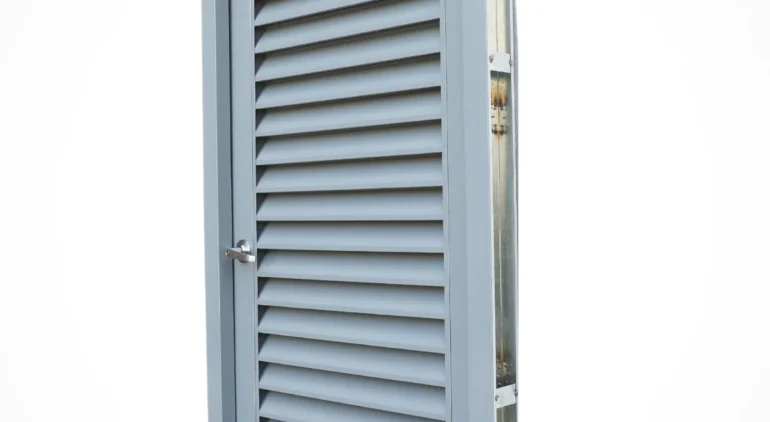
Louver Doors in Quezon City
Louver Doors in Quezon City: Ventilation and Access in a Single Fabricated System
In a city as densely built and heavily populated as Quezon City, the management of airflow within buildings is not a luxury consideration — it is a functional and regulatory requirement that affects equipment performance, occupant comfort, and in many cases, building code compliance. Electrical rooms must be ventilated to prevent heat buildup that shortens equipment lifespan. Mechanical rooms require continuous airflow to support HVAC and utility equipment operation. Storage areas need air circulation to prevent the humidity accumulation that damages inventory and building materials in Metro Manila’s year-round tropical conditions.
The louver door is the fabricated solution that addresses this requirement at the access point itself — a door that allows continuous passive ventilation through its blade geometry while still functioning as a secure, lockable barrier to the space it protects. When that door is fabricated correctly, with consistent blade angles, a square frame, and appropriately reinforced hinge and lock points, it delivers decades of trouble-free ventilation and access function without maintenance. When it is not fabricated correctly, the problems announce themselves quickly — uneven airflow, rain infiltration, binding operation, and progressive structural deterioration that no amount of adjustment can fully correct.
For facility managers, building contractors, and property developers sourcing louver doors in Quezon City, fabrication quality is the specification that determines long-term performance. Boswell Limited Co., a steel fabrication company based in Malabon since 2005, produces louver door components with CNC-driven precision across the full material range that Quezon City’s diverse building stock requires.
The Functional Anatomy of a Properly Fabricated Louver Door
A louver door is a structurally complete door assembly — not simply a door frame with blades inserted into it. Each component plays a specific role in the system’s ventilation performance, structural integrity, and operational reliability.
The Door Frame provides the structural perimeter within which the blade assembly is mounted, and must be fabricated square along both its height and width. Frame squareness is not a cosmetic requirement — it is a functional one. A frame that is out of square distributes blade mounting positions unevenly, creating blade pitch inconsistencies across the door’s height that manifest as uneven airflow distribution and localized gaps in weather resistance. At the door’s operational level, a frame that is out of square produces the binding and latching problems that become the dominant maintenance issue for the door’s entire service life.
The Blade Assembly is the ventilation-active section of the door, where angled blades create the geometry that allows air passage while deflecting rain and debris. The effectiveness of this geometry depends entirely on blade consistency — every blade in the assembly must share the same angle, the same cross-sectional profile, and the same spacing relative to adjacent blades. A louver door’s blade assembly is only as effective as its least consistent blade, since any blade that deviates from the designed geometry creates a localized weak point in both weather resistance and airflow performance.
The Stiles and Rails are the vertical and horizontal structural members that frame the blade section within the door, providing the rigidity that keeps the blade assembly flat and properly positioned despite the inherently open, perforated nature of the louver section. Without adequate stile and rail section strength, louver doors deflect under wind load in ways that change blade pitch dynamically — opening gaps that allow rain infiltration when wind pressure is highest, exactly when weather resistance matters most.
Hinge Reinforcement at the hinge mounting locations on both the door and the frame must be adequate to carry the door’s weight and the dynamic loads of repeated operation without the fastener pull-through that causes louver doors to sag progressively over their early service life. A sagging louver door does not just look poor — it creates a gap at the latch side that compromises both security and weather sealing at the most critical point in the door’s perimeter.
Lock Area Construction at the latch and deadbolt locations requires reinforced backing that resists the mechanical loads of lock operation and the forced entry attempts that commercial and institutional doors in Quezon City’s urban environment must be built to withstand.
Why CNC Forming Is the Right Production Method for Louver Blades
Louver door blade forming is a precision task that reveals the difference between CNC and manual fabrication more clearly than most sheet metal operations, because the quality indicator — consistent blade angle across the full door height — is directly visible to anyone who looks at the installed door from close range and traceable to ventilation performance through airflow measurement.
Manual blade forming requires the operator to set up the press brake for each blade bend, verify the angle against a template or protractor, and adjust as needed before confirming the bend. Over a production run of dozens of blades — enough to fill several louver doors — this process introduces progressive variation as tooling wears, material batch properties vary, and operator attention fluctuates. The resulting blade set contains individual blades that deviate from the design angle by varying amounts, producing a door assembly where some blade gaps are wider than others and some overlap less completely than intended.
CNC press brake forming inverts this dynamic. The blade angle and spacing are programmed once, and the machine executes that program on every blade in the run with the same accuracy regardless of position in the sequence. The first blade and the last blade are identical to the same tolerance as every blade between them, because the forming operation is driven by the program rather than by per-piece operator judgment.
For Quezon City clients ordering louver doors in any quantity beyond a single unit, this consistency means every door in the order performs identically — which matters for institutional and commercial clients specifying louver doors across multiple identical openings in the same facility.
Material Options for Quezon City Louver Door Applications
The range of building types and use categories in Quezon City generates louver door requirements across multiple material categories, and the correct choice depends on the specific environmental exposure and functional demands of each installation.
Carbon Steel — galvanized or powder coated — is the standard material for most commercial and industrial louver doors in Quezon City’s equipment rooms, utility spaces, and industrial facility access points. Carbon steel provides the structural strength and rigidity that large louver door assemblies require at a material cost that is appropriate for non-corrosion-critical applications where finish maintenance is part of the building’s normal upkeep program.
Stainless Steel louver doors are specified for Quezon City’s significant healthcare, food service, and pharmaceutical facility base, where doors face regular chemical cleaning, high-humidity conditions, and the corrosive environments that these activities generate. A stainless louver door in a hospital mechanical room or food processing facility maintains its structural and surface integrity through the cleaning protocols these environments impose without the coating maintenance that carbon steel requires to achieve comparable corrosion resistance.
Aluminum louver doors are selected for applications where reducing door weight is a functional requirement — large-format openings where door mass would make manual operation difficult, or installations where the supporting structure has load limitations. Aluminum’s natural corrosion resistance is particularly valuable for exterior-facing louver doors in Quezon City’s rain-exposed locations, where the material performs without coating maintenance in conditions that would progressively degrade painted or galvanized steel.
Ventilation Performance Calculations: Matching the Door to the Requirement
A louver door’s free area — the total open area through which air can pass when the door is installed — determines whether it provides the ventilation volume that the space behind it requires. Free area is determined by the blade pitch, the blade profile geometry, and the proportion of the door’s total area occupied by the blade section versus the solid frame and stile elements.
For equipment rooms with specific ventilation requirements defined by electrical or mechanical codes, the louver door specification must be confirmed against the required ventilation rate before the door is ordered. Selecting a louver door based on overall door dimensions without verifying that its blade geometry provides the required free area is a specification error that produces a compliant-looking installation that fails to meet the ventilation requirement it was installed to satisfy.
Boswell’s pre-production consultation process includes review of ventilation requirements where clients provide them, confirming that the blade pitch and free area of the specified door configuration meet the application’s ventilation needs before production begins.
Quezon City’s Specific Challenges for Louver Door Installations
Quezon City’s urban density creates specific installation contexts that affect louver door specification in ways that differ from suburban or provincial building environments.
Typhoon-season wind loads in Quezon City can be significant, particularly for buildings on elevated sites or in exposed urban locations. Louver doors on exterior or semi-exterior locations in these contexts need frame and stile sections sized to resist the wind pressure loads that typhoon-season conditions generate without deflecting to the point where blade pitch changes dynamically or frame joints open under load.
The city’s sustained high humidity creates corrosion exposure that affects carbon steel louver components more aggressively than drier environments, making surface preparation and finish quality more critical than in lower-humidity locations. Boswell’s finishing process accounts for this, with substrate preparation standards appropriate for Metro Manila’s humidity before any protective coating is applied.
Boswell Limited Co.: Louver Doors for Quezon City’s Buildings and Facilities
Since 2005, Boswell has fabricated metal components for clients across Quezon City and Metro Manila’s construction, industrial, and institutional sectors. Louver door production draws on the same CNC forming precision, material knowledge, and structural engineering discipline that the company applies across its full fabrication range — producing doors where blade consistency, frame squareness, and hinge reinforcement meet the performance requirements of the specific application rather than a generic commercial standard.
If your building or facility project in Quezon City requires louver doors that deliver reliable ventilation performance and long service life in Metro Manila’s demanding urban climate, Boswell Limited Co. has the fabrication capability and engineering process to deliver them correctly.
Contact Boswell Limited Co. to discuss specifications for your next louver door project in Quezon City.