

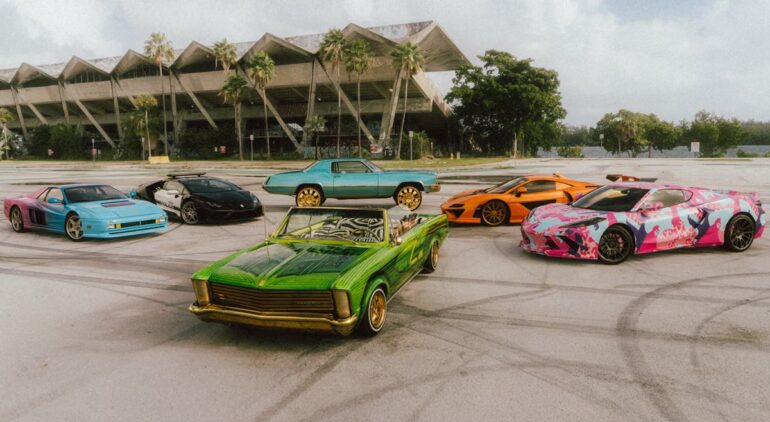
How West Coast Customs Built Six Real GTA VI Vehicles
How Metal Fabrication Brought Six GTA VI Vehicles to Life
Building a custom vehicle inspired by a video game requires more than installing a body kit and applying an eye-catching paint finish. It involves metalworking, precision machining, composite construction, and careful attention to the proportions of the original design.
Rockstar Games partnered with Los Angeles-based West Coast Customs to recreate six vehicles from Grand Theft Auto VI (GTA VI) as functional, real-world cars. The project combines traditional automotive fabrication with modern manufacturing techniques, including CNC machining and composite body construction.
The completed vehicles were photographed and filmed around Miami, Florida, wearing Leonida license plates inspired by the fictional setting of GTA VI. Their appearance is part of the game’s promotional campaign ahead of its November 19, 2026 release for PlayStation 5 and Xbox Series X|S.
The Six GTA VI Vehicles Recreated by West Coast Customs
The project features six recognizable vehicles from the upcoming game. Their designs draw inspiration from different automotive categories, including European performance cars and American custom vehicles.
1. Grotti Cheetah
The Grotti Cheetah takes inspiration from the 1980s Ferrari Testarossa, particularly its distinctive low profile and wide body proportions.
The Testarossa became widely recognized through the television series Miami Vice, where it was driven by character Sonny Crockett. The Cheetah has also appeared in previous Grand Theft Auto games, including GTA III and the original Vice City.
In GTA VI, the Cheetah ’95 is included as an Ultimate Edition vehicle that becomes available later in the story.
2. Pegassi Tempesta
The Pegassi Tempesta is based on the Lamborghini Huracán, a high-performance Italian sports car known for its aggressive styling and distinctive proportions.
West Coast Customs gave the recreated vehicle a police-inspired finish. The design references Lamborghini Huracán vehicles used by Italian state police.
This particular build demonstrates how custom paintwork and vehicle graphics can transform the appearance of an existing automotive platform.
3. Progen Emerus
The Progen Emerus draws inspiration from the McLaren Senna, a high-performance hypercar introduced in 2018 and limited to 500 units.
The vehicle’s design emphasizes aerodynamic bodywork and an aggressive performance-oriented appearance. Reproducing these characteristics in a physical vehicle requires careful attention to body proportions and the integration of custom exterior components.
4. Invetero Coquette
The Invetero Coquette represents the Chevrolet Corvette in the Grand Theft Auto universe. For the latest recreation, the design takes inspiration from the mid-engine C8 Corvette.
The C8’s engine layout and distinctive exterior proportions make it a recognizable reference for the fictional vehicle.
5. Albany Manana
The Albany Manana moves away from European supercar styling and embraces American automotive customization.
Its design takes inspiration from the late-1960s Cadillac Eldorado and features tall hi-riser wheels associated with the donk customization scene in South Florida.
This style emphasizes visual height, distinctive wheel arrangements, and modifications that give traditional American cars a different road presence.
6. Albany Buccaneer
The Albany Buccaneer combines styling elements associated with the 1970s Buick Riviera and Ford Fairlane.
Unlike the elevated Manana, the Buccaneer is configured as a lowrider, featuring smaller wheels and an aggressive front grille. One of the Albany builds was reportedly finished with green paint, gold wheels, and a zebra-pattern interior.
Together, the two Albany vehicles demonstrate the project’s range, covering both classic American customization and European-inspired performance styling.
Metal Fabrication, Composite Panels and CNC Machining
Beyond their appearance, the six vehicles provide an interesting example of how different manufacturing processes can work together during a custom automotive project.
According to the report, West Coast Customs combined conventional metal fabrication with composite body panels. The shop also used CNC machining to manufacture custom wheels and structural components before completing each vehicle with an individual paint finish.
Traditional metal fabrication
Metal fabrication remains an important part of custom vehicle construction. Processes such as cutting, shaping, forming, welding, and joining allow fabricators to modify existing automotive structures and produce components that match a particular design.
For projects involving extensive exterior modifications, dimensional accuracy is especially important. Poorly fitted panels or inconsistent alignment can affect the appearance of the finished vehicle and create additional work during assembly.
Composite body construction
Composite materials provide another option for producing customized automotive exterior components. Depending on the material and manufacturing method, composites can be shaped into complex body profiles that would be more difficult or expensive to produce using conventional sheet metal alone.
They are particularly useful for specialized bodywork where styling, weight considerations, and surface geometry influence the final design.
CNC machining for precision components
Computer Numerical Control (CNC) machining uses programmed instructions to control cutting tools and produce components with precise dimensions.
For the GTA VI project, CNC machining was used for custom wheels and structural parts. This application demonstrates how digitally controlled manufacturing can support one-off automotive builds that require consistent geometry and specialized components.
Unlike manually producing every component through conventional machining, CNC equipment can follow repeatable tool paths. This makes it useful for producing detailed parts that need to match a particular design.
Custom paint and finishing
The final stage involved applying bespoke paint finishes to the six vehicles. Automotive finishing is important because it influences both the visual appearance and the overall presentation of fabricated components.
Surface preparation, panel alignment, and finishing quality all contribute to the result. Even accurately manufactured components can look unfinished if the paintwork and final assembly are inconsistent.
Miami Locations Give the Vehicles a Real GTA VI Setting
The promotional vehicles were photographed at recognizable locations around Miami, helping connect the real-world builds with the game’s fictional Leonida environment.
Two locations featured in the photographs were 1111 Lincoln Road in Miami Beach and Miami Marine Stadium on Virginia Key.
1111 Lincoln Road is a parking structure designed by Herzog & de Meuron. Its distinctive architectural appearance provides an interesting background for automotive photography.
The second location, Miami Marine Stadium, was designed by architect Hilario Candela and opened in 1963. The facility has remained closed since Hurricane Andrew in 1992.
The Notebookcheck report also noted that nearly 69% of Miami voters supported a referendum in August that cleared the way for restoration of the stadium.
The vehicles were first spotted on Miami roads in mid-October, shortly after Rockstar released the GTA VI launch trailer on October 15. Their appearances formed part of a larger promotional campaign that also included a branded blimp, beach merchandise, and advertising banners carried by aircraft over South Beach.
West Coast Customs Has Previous Experience with Rockstar Games
The collaboration is not the first time West Coast Customs has created a physical vehicle based on a Grand Theft Auto design.
In 2013, the Los Angeles shop produced a real-world version of the Bravado Banshee from GTA V. That vehicle was constructed using a Dodge Viper as its foundation and was designed to closely resemble its video game counterpart.
The completed Banshee was subsequently awarded as a promotional prize.
West Coast Customs is also widely recognized for its appearance on MTV’s Pimp My Ride, where customized vehicles and extensive automotive transformations became the central focus.
The six-car GTA VI project expands on that earlier collaboration by combining several different automotive styles and manufacturing techniques into one promotional campaign.
What Automotive Fabricators Can Learn from the Project
Although the Rockstar collaboration is an entertainment project, its manufacturing approach offers useful lessons for automotive fabricators, metalworking businesses, and custom vehicle builders.
One important consideration is selecting the appropriate manufacturing process for each component. Metal fabrication, composite construction, and CNC machining serve different purposes, and combining them can provide greater flexibility when producing complex automotive designs.
Before starting a similar custom fabrication project, consider these practical points:
Check the original vehicle structure: Identify which components can be modified and which structural areas must remain intact.
Choose suitable materials: Consider the intended application, strength requirements, weight, durability, and compatibility of metal and composite components.
Confirm dimensional accuracy: Use accurate measurements and fabrication drawings before producing custom panels, wheels, and structural parts.
Evaluate CNC machining requirements: Determine whether custom components require CNC milling, turning, or another manufacturing process based on their geometry and tolerances.
Plan the finishing process: Allow sufficient time for surface preparation, fitting, painting, and final assembly.
Is CNC machining suitable for custom automotive parts?
Yes. CNC machining can produce custom wheels, brackets, mounting components, and other precision parts. The appropriate machining method depends on the material, component geometry, required tolerances, and intended application.
Can composite panels be combined with metal fabrication?
Yes. Composite body panels can be integrated with metal automotive structures when the materials, mounting arrangements, and joining methods are properly designed. The connection points and compatibility of the materials should be evaluated before fabrication begins.
What should you check before hiring an automotive fabricator?
Review the fabricator’s previous projects, equipment, material capabilities, measurement procedures, and finishing quality. For structural modifications, also verify that the work follows applicable vehicle safety and engineering requirements.
As GTA VI approaches its November 19, 2026 launch, the six West Coast Customs builds demonstrate how traditional metalworking and modern manufacturing technologies can come together in automotive customization. For fabrication businesses, the project is another example of how accurate machining, carefully selected materials, and detailed finishing can turn a digital vehicle design into a functional physical creation.
Anyone planning a similar project should begin with accurate design references, a clear material specification, and a fabrication plan that identifies which components require metalworking, composite construction, or CNC machining.