

Base Plates in Valenzuela
Base Plates in Valenzuela: Why the Most Critical Structural Component Demands the Most Precise Fabrication
Of all the fabricated steel components in a building or industrial structure, the column base plate is arguably the one where dimensional error carries the highest consequence. Every load in the structure above — floor systems, walls, roof, live loads, wind loads — eventually traces its path down through the columns and into the base plates anchoring those columns to the foundation below. A base plate that is incorrectly dimensioned, improperly drilled, or fabricated from the wrong material specification does not just create an installation problem. It creates a structural problem that may not become visible until well after construction is complete.
For structural engineers, contractors, and project managers sourcing base plates in Valenzuela and across Metro Manila, the fabrication supplier they choose for this component matters more than it does for almost any other steel element on the project. Boswell Limited Co., a steel fabrication company operating out of Malabon since 2005, has built its structural component capability specifically around the dimensional precision that base plate fabrication requires — combining CNC cutting and drilling with material knowledge developed across two decades of construction-related fabrication work.
What a Column Base Plate Actually Does
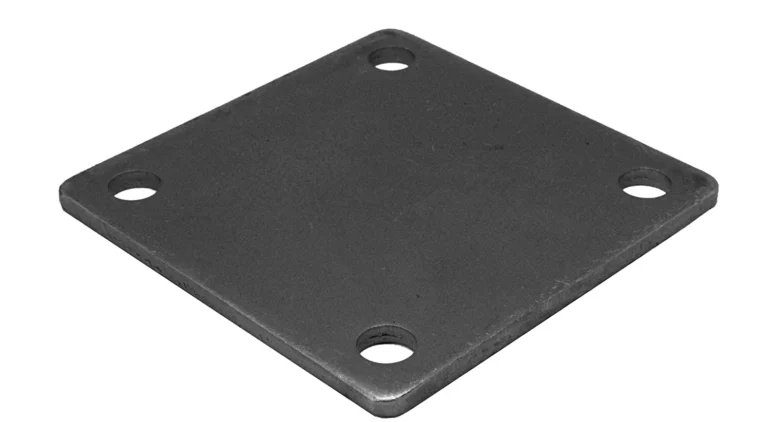
A column base plate is a flat steel plate, typically ranging from 12mm to 50mm or more in thickness depending on the column load and structural engineering specification, that sits between the bottom of a structural column and the concrete foundation below. It serves three distinct structural functions simultaneously.
First, it distributes the concentrated point load at the base of the column across a larger area of the concrete foundation surface, reducing the bearing stress on the concrete to a level the foundation can safely carry. A column transferring hundreds of kilonewtons of load into a small contact area without a base plate would exceed the bearing capacity of virtually any concrete element — the plate spreads that load across its full footprint.
Second, it provides the connection interface between the steel column above and the anchor bolt system embedded in the concrete below. Anchor bolts are cast into the foundation in a specific pattern that matches the bolt hole layout of the base plate, and the plate transfers both compression loads downward and tension and shear forces laterally through these bolt connections.
Third, in moment-resisting connections, the base plate and its anchor bolt group work together to transfer overturning moments from the column into the foundation — a more complex structural function that places even greater demands on the accuracy of the bolt hole pattern and the plate’s dimensional consistency.
Why Dimensional Accuracy Is Non-Negotiable in Base Plate Fabrication
The consequences of dimensional error in a base plate play out in two distinct ways, both of them costly.
The first is a field fit-up failure — the anchor bolts cast into the concrete foundation do not align with the holes drilled in the base plate. This is one of the most common and most disruptive fabrication errors on construction sites, and it happens when base plates are drilled manually without adequate process controls. Correcting a misaligned base plate after the foundation concrete has cured typically requires field drilling of the plate on site, potentially under already-erected structural elements, or in extreme cases involves breaking out and re-pouring foundation sections — delays measured in days or weeks, not hours.
The second consequence is structural. A base plate fabricated to incorrect dimensions, or in the wrong material grade or thickness, may meet the visual expectation of a base plate while failing to meet the engineering specification. This type of error is often invisible at installation — the plate fits, the column goes up, the structure is erected — and the deficiency only becomes apparent later, either during a structural audit or, in the worst case, under load.
Both types of failure trace back to the same root cause: fabrication without adequate dimensional control. CNC cutting and drilling directly address that root cause.
CNC Precision Applied to Base Plate Production
Boswell’s production process for structural base plates begins with the engineering drawing or digital file, which defines the plate dimensions, thickness, anchor bolt hole pattern, and any additional features such as shear key slots or stiffener connection holes. Before any steel is cut, the engineering team reviews the file for manufacturability — confirming that specified tolerances are achievable, that hole edge distances meet standard fabrication minimums, and that the material specification matches what is available in the required thickness.
Once the drawing is confirmed, the cutting program is generated. Laser cutting or plasma cutting on CNC equipment produces plate perimeters accurate to fractions of a millimeter, with consistent squareness across every plate in the order. Anchor bolt holes are drilled or punched from the same programmed file, ensuring that hole positions match the engineering drawing exactly — not approximately, and not dependent on a technician’s manual layout interpretation.
This accuracy is what allows base plates fabricated at Boswell’s shop in Malabon to arrive on a construction site in Valenzuela and drop directly over the cast-in anchor bolts without field modification. The plate was made to the drawing; the drawing matches the anchor bolt template; the template was used to position the bolts during concrete placement. When every step of that chain is executed correctly, field erection becomes straightforward.
Material Specification for Structural Base Plates
Base plate material selection is driven by the structural engineering specification, which accounts for the column load magnitude, the connection type, and the environmental exposure the plate will face.
Structural Carbon Steel — typically conforming to ASTM A36 or equivalent Philippine standard grades — is the default specification for most column base plates in building and industrial construction. A36 offers the combination of yield strength, weldability, and consistent mechanical properties that structural connection design depends on, and it is available in the full range of plate thicknesses that base plate engineering requires.
Higher-Strength Carbon Steel grades are specified when the structural engineer determines that standard-grade steel would require impractically thick plates for the column loads involved, such as in heavily loaded industrial frames or multi-story building columns carrying significant accumulated floor loads.
Stainless Steel base plates are specified in aggressive corrosive environments — coastal structures, wastewater treatment facilities, chemical plant structures, and food processing facilities — where the long-term corrosion resistance of stainless justifies its higher material cost compared to painted or galvanized carbon steel.
Boswell sources and fabricates in all of these material categories, allowing base plate orders to be produced from the engineering-specified material rather than substituting a convenient alternative.
Welded Assemblies and Stiffened Base Plates
For heavier column loads or moment-resisting connections, a flat base plate alone is not always sufficient. Stiffened base plates incorporate welded steel ribs or gussets extending from the plate surface up into the column section, increasing the plate’s effective bending resistance under eccentric or moment loads without requiring impractically thick plate stock.
Fabricating a stiffened base plate assembly requires more than cutting — it requires welding that maintains the plate’s flatness and the stiffener’s perpendicularity to the plate surface, since distortion introduced during welding can compromise both the structural function and the fit-up against the foundation bearing surface. Boswell’s welding capability and post-weld handling practice account for this, producing stiffened plate assemblies that arrive flat and ready for installation rather than requiring straightening on site.
Surface Flatness: The Specification Detail That Often Gets Overlooked
Base plate surface flatness — the degree to which the bottom bearing surface is genuinely planar rather than slightly bowed or warped — is a specification detail that does not always receive explicit attention but directly affects how the plate transfers load into the foundation.
A base plate with a convex bottom surface rocks on the foundation rather than bearing flat, concentrating load at the plate’s center rather than distributing it across the full plate footprint. This concentrates bearing stress on a smaller concrete area than the plate’s footprint would suggest, potentially exceeding the foundation’s design bearing capacity at that localized zone.
Boswell’s CNC cutting process produces plates from flat rolled stock with consistent thickness, and the post-production handling process protects that flatness through delivery — ensuring the bearing surface the structural engineer specified is the bearing surface that actually reaches the site.
Boswell Limited Co.: Base Plates Built to Engineering Specification
Since 2005, Boswell has supplied structural steel components to construction and industrial projects across Metro Manila, developing the fabrication discipline that structural base plates specifically demand. The investment in CNC cutting and drilling equipment since 2015 has brought the company’s dimensional accuracy to the level that construction-grade tolerances require — plates cut to drawing dimensions, holes drilled to programmed positions, and materials sourced to engineering-specified grades.
If your construction or industrial project requires precision-fabricated base plates in Valenzuela or anywhere across Metro Manila, Boswell Limited Co. has the production capability and structural fabrication experience to deliver components that install correctly the first time.