

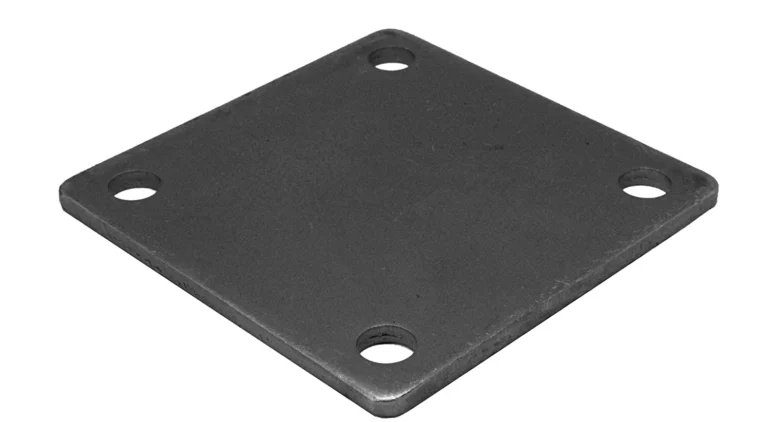
Base Plates in Quezon City
Base Plates in Quezon City: Precision Fabrication for the Component That Carries Every Load Above It
In the structural hierarchy of a building, the column base plate occupies a position of disproportionate importance relative to its apparent simplicity. It is a flat piece of steel — no moving parts, no complex geometry in most cases, no visible role in the finished building once it is buried under flooring or concealed within a column enclosure. Yet every load in the structure above it — the weight of every floor slab, every wall, every beam, every person and piece of equipment occupying the building — travels through the columns and arrives at the base plate before transferring into the foundation system below.
The structural consequence of a base plate that does not meet its engineering specification is not always immediately visible. A plate with undersized anchor bolt holes may accept the bolts with difficulty, or require field reaming that introduces edge distance violations the structural engineer was not informed about. A plate fabricated from the wrong material grade may appear identical to the correct specification but carry a lower yield strength than the design assumed. A plate with incorrectly positioned holes may force column misalignment that compromises the entire structural frame’s plumb and geometry, with effects that propagate upward through every floor of the building.
For structural engineers, contractors, and project managers sourcing base plates in Quezon City and across Metro Manila’s active construction market, the fabrication supplier’s dimensional accuracy and material discipline are the variables that determine whether base plate procurement is a straightforward part of the construction process or a source of field problems that delay erection and require engineering intervention to resolve. Boswell Limited Co., a steel fabrication company based in Malabon since 2005, produces structural base plates using CNC cutting and drilling processes that deliver the dimensional accuracy that construction-grade base plate fabrication demands.
Quezon City’s Construction Scale and Its Base Plate Demand
Quezon City’s sustained construction activity generates base plate demand that spans the full range of structural applications — from light commercial structures with modest column loads and simple base plate configurations, to high-rise residential and commercial buildings with heavily loaded columns requiring thick plates with multiple anchor bolt groups, to institutional facilities with complex structural programs that generate non-standard connection geometries not served by catalog products.
This breadth of demand reflects Quezon City’s diversity as a built environment. The university campuses of UP Diliman, Ateneo, and La Salle generate institutional construction with complex building programs. The commercial districts of Cubao, Trinoma, and Eastwood generate retail and mixed-use construction with standard structural programs at significant scale. The residential development activity across the city’s various barangays generates mid-rise and high-rise construction with repetitive structural components in large quantities. Each of these project types has different base plate requirements, and the fabricator serving Quezon City’s construction market needs to handle all of them within the same production capability.
Boswell’s CNC fabrication process is equally effective across this range — producing a single custom base plate to a non-standard engineering specification with the same dimensional accuracy it brings to a batch of five hundred identical plates for a repetitive structural grid.
What Makes a Base Plate Fabrication Specification Correct
A base plate specification consists of several interdependent parameters, each of which must be correct for the plate to function as the structural engineer designed.
Plate Dimensions — length, width, and thickness — are the foundation of the specification. Plate thickness is the most structurally critical of these dimensions because it determines the plate’s bending stiffness under the eccentric loading that column loads impose when they are not perfectly centered over the anchor bolt group. A plate that is thinner than specified is softer in bending than the design assumed, potentially allowing deformation under load that concentrates bearing stress non-uniformly on the foundation surface below.
Anchor Bolt Hole Positions are the dimensional specification where fabrication error has the most immediate and visible construction consequence. Hole positions are defined in the engineering drawing as distances from the plate’s edges and centerlines, with tolerances that reflect the positioning capability of the anchor bolt installation method used in the foundation. When hole positions are drilled by CNC from a programmed file derived from the engineering drawing, the accuracy is consistent and traceable. When holes are laid out and drilled manually, the accuracy is operator-dependent and variable — and the variation shows up at erection as the anchor bolt fit-up problems that delay steel erection on construction sites across Quezon City.
Hole Diameter and Edge Distance are related parameters that affect both fit-up and structural performance. Hole diameters must accommodate the anchor bolt diameter plus the installation clearance specified in the structural drawings, while maintaining the minimum edge distances that the connection’s bearing and tearout capacity calculations require. Holes drilled too large reduce the plate’s effective bearing area at the bolt; holes drilled too close to the plate edge reduce the connection’s tearout resistance below what the structural calculation assumed.
Material Grade and Certification must match the structural specification, with mill certificates available to verify that the plate material’s mechanical properties — yield strength, tensile strength, and elongation — meet the grade requirements the structural engineer specified. Substituting a lower grade material that visually resembles the specified grade but carries lower yield strength is a structural compromise that cannot be detected visually at installation and may only become apparent under load.
CNC Cutting and Drilling: How Boswell Achieves Consistent Base Plate Accuracy
The production process for structural base plates at Boswell begins with the engineering drawing or digital file submitted by the client or their structural engineer. Before any steel is cut, the engineering team reviews the drawing for completeness and manufacturability — confirming that the plate dimensions, hole positions, and edge distances are fully specified and that the material grade and thickness are available in the required size.
Once the drawing is confirmed, the CNC program is generated. Plate perimeter geometry is cut by laser or plasma on CNC equipment, producing edges that are square and consistent with the dimensional accuracy that the plate’s overall size allows. Anchor bolt holes are programmed as absolute coordinate positions derived from the engineering drawing’s hole location dimensions — not as manual layout dimensions that an operator measures and marks on the plate surface.
The machine then executes the cutting and drilling program, positioning each hole to its programmed coordinates with positional accuracy that CNC equipment consistently achieves in the range required for structural connection fabrication. Every plate produced from the same program shares the same hole positions, ensuring that any plate in a batch of identical components is interchangeable with any other without individual fitting.
Stiffened Base Plates: When Standard Flat Plates Are Not Sufficient
For heavily loaded columns or moment-resisting base connections, the structural engineer may specify a stiffened base plate — an assembly where vertical steel ribs or gussets are welded to the plate surface and extend up into the column section, increasing the plate’s effective bending stiffness without requiring impractically thick flat plate stock.
Stiffened base plate fabrication adds welding to the CNC cutting and forming process, and welding on heavy plate introduces heat that can distort the plate’s flatness — the bearing surface characteristic that determines how uniformly the plate transfers load to the foundation. Managing this distortion through controlled weld sequence and post-weld handling is part of the fabrication process for stiffened plates, not an afterthought.
Boswell’s welding capability on structural components accounts for the distortion risk that stiffener welding introduces, producing stiffened base plate assemblies that arrive flat and ready for installation rather than requiring straightening that risks introducing residual stress at the weld joints.
The Anchor Bolt Template: Preventing Field Fit-Up Problems Before They Happen
A base plate that fits the anchor bolts perfectly is only achievable if the anchor bolts were installed in the correct positions during concrete placement. The tool that controls anchor bolt position during placement is the anchor bolt template — a fabricated steel plate or frame that matches the base plate’s hole pattern exactly and is used to position the bolts while the concrete is poured and cured around them.
Fabricating anchor bolt templates from the same CNC program used to produce the base plates ensures that template hole positions and base plate hole positions share the same dimensional reference. When the template is used correctly during foundation construction, the anchor bolts emerge from the cured concrete in positions that match the base plates, and erection proceeds without fit-up problems.
Boswell produces anchor bolt templates as part of base plate project packages for clients who need to coordinate foundation construction with structural steel erection — a service that prevents the most common and most costly source of base plate field fit-up problems before they have a chance to develop.
Surface Protection for Base Plates in Quezon City’s Construction Environment
Structural base plates installed in Quezon City’s humid climate require appropriate surface protection to resist the corrosion that untreated carbon steel develops in the presence of moisture — particularly during the construction period before the plate is enclosed within the finished building structure.
Primer coating applied before delivery protects the plate surface during the construction period and provides the base for any topcoat system applied as part of the building’s structural steel protection program. Galvanizing provides more durable corrosion protection for plates installed in permanently exposed or semi-exposed locations — exterior structure, parking facilities, and industrial buildings where the plate is not fully enclosed by the finished building envelope.
Boswell Limited Co.: Base Plate Fabrication Serving Quezon City’s Construction Market
Since 2005, Boswell has supplied structural steel components to construction projects across Metro Manila, developing the CNC fabrication capability and structural material knowledge that base plate production for a major urban construction market requires. The combination of programmed hole position accuracy, consistent plate thickness from certified material, and structural welding capability for stiffened plate assemblies positions Boswell as a base plate fabrication supplier that construction projects in Quezon City can rely on for components that install correctly and meet their structural specification.
If your construction project in Quezon City requires precision-fabricated column base plates — from simple flat plates to complex stiffened assemblies — Boswell Limited Co. has the production capability and engineering process to deliver them on specification and on schedule.
Contact Boswell Limited Co. to discuss base plate specifications for your next construction project in Quezon City.