

Welding Slag Basics: How to Remove It and Avoid Defects
The Crust That Looks Like Trouble but Does a Job
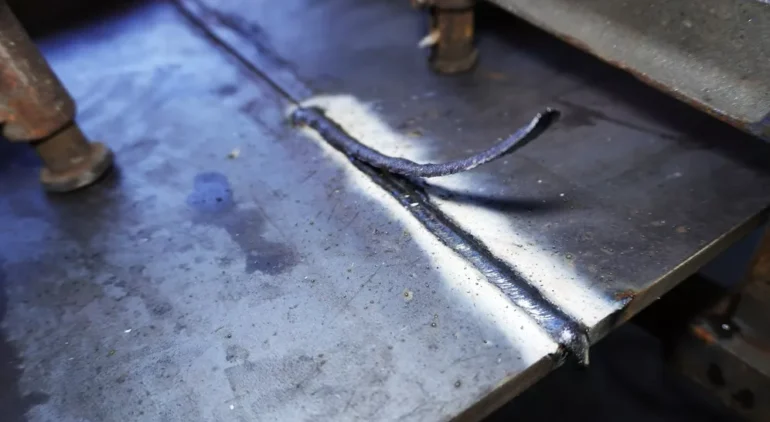
Walk through any steel fabrication shop after a stick or flux-cored pass and you will see it: a dark, brittle crust sitting on top of a fresh bead. It looks like waste, and eventually it is. But for a few critical seconds, that crust is working for the weld.
Understanding what slag does, and when it has to go, is one of the simplest ways to protect weld quality on structural steel, plate work, and heavy fabrication.
What Welding Slag Actually Is
Slag is a solidified, non-metallic layer left on the weld surface. It is a byproduct of processes that use flux, including submerged arc welding (SAW), shielded metal arc welding (SMAW), and flux-cored arc welding (FCAW).
During welding, impurities that cannot become part of the weld metal are pushed out through chemical reactions. They float to the top of the molten pool and harden into slag.
Why Slag Is Useful While the Weld Is Hot
Molten metal is fluid and vulnerable. It is far more prone to defects while it is still hot and in the cooling period right after welding.
The slag layer shields that vulnerable metal while it cools. It also helps hold the molten pool in place when the welder is working at awkward angles, which is one reason flux-cored and stick processes are popular for out-of-position work.
Why It Has to Come Off
Once the weld has cooled, the slag stops helping. It adds nothing to the strength of the joint, and it hides the weld surface, which makes visual inspection impossible.
There is a bigger problem too. If a welder lays another pass over old slag, the non-metallic layer can prevent proper fusion between passes. That is how a cleanup shortcut turns into a rejected weld.
Removing slag is also easier at the right moment. Hardened slag that has been left too long is harder to take off without damaging the weld beneath it.
Common Ways to Remove Slag
Most shops rely on a short list of tools, and the right choice depends on the weld type and the joint.
Chipping hammers
A chipping hammer has a pointed tip on one end that breaks up large chunks of slag quickly. It is the first tool most welders reach for after a stick or flux-cored pass.
Wire brushes
A wire brush clears the finer residue left after chipping. Between passes in a multi-pass joint, chipping followed by brushing is the standard routine.
Angle grinders
Power tools, including angle grinders fitted with grinding discs or wire brush wheels, speed up the job on longer seams. Grinding takes more care, because it can remove base metal along with the slag if the operator is not paying attention.
Flame cleaning
Flame cleaning is another option some shops use. It is less common than chipping and brushing for routine work.
What Slag Inclusion Is and How It Happens
Slag inclusion means non-metallic material has been trapped inside the weld metal instead of floating out. It is one of the more common weld defects, listed alongside cracks, porosity, undercut, spatter, and overlap in training material from Universal Technical Institute.
The usual causes are practical ones:
Travel speed that is too fast. The slag does not get enough time to rise out of the pool.
Poor surface preparation. Leftover slag or contamination from earlier operations gets buried by the next layer.
Incorrect technique. A poor torch or electrode angle can trap slag in the pool.
Rapid cooling. If the pool freezes too quickly, slag cannot escape before it solidifies.
ESAB’s welding defects guide adds a few joint-level causes for slag inclusions: incomplete removal between passes, restricted access in the groove, excessive weave or deposition, and poor bead overlap.
Finding and Fixing Slag Inclusions
Some inclusions sit near the surface, and a visual check will catch them. Others lie deep in the weldment. In those cases, X-ray or ultrasonic testing is how inspectors locate them.
When an inclusion turns up, the fix is to grind or excavate the affected area, clean it thoroughly, and re-weld with better sequencing and interpass cleaning. ESAB notes that defects should be judged against the applicable ISO, AWS, or ASME acceptance criteria.
How to Prevent Slag Problems
Prevention comes down to habits that are easy to describe and easy to skip when a job is running behind.
Chip and brush every pass. Design grooves so the welder can actually reach the bottom of the joint. Control weave width and pauses, and follow the specified pass sequence.
Clean the base metal before welding. Moisture, oil, and dust all contribute to defects. Filler choice matters as well: rutile fluxes, for example, promote a flatter bead, and the slag rises to the top and collects where it is easy to reach.
For FCAW specifically, slag removal is needed after each pass, which adds cleanup time. Travel speed and settings that are off can also lead to porosity or slag inclusions, according to the American Welding Society’s Welding Digest.
What to Ask Before You Hire a Fabricator
If your project involves multi-pass welds on structural steel, a few questions will tell you a lot about a shop.
Ask how they handle interpass cleaning and whether it is written into their welding procedure. Ask which inspection methods they use beyond visual checks, and whether they test to AWS, ASME, or ISO criteria. A shop that can answer these without hesitation usually has the process under control.
Frequently Asked Questions
Can you leave slag on a weld?
No. Slag protects the weld briefly while it cools, but it should be removed after that. Leaving it can hide defects and cause fusion problems if another pass is added on top.
Which welding processes produce slag?
Submerged arc welding, shielded metal arc welding, and flux-cored arc welding all produce it. Processes that do not use flux generally do not leave a slag layer to clean off.
How do you check for slag inclusions inside a weld?
Surface inclusions can be spotted visually. Deeper ones usually need X-ray or ultrasonic testing.
What to Check Before Your Next Project
Before you start, confirm that the welding procedure covers cleaning between passes and that the inspection method matches the joint. For critical structural work, settle the acceptance criteria up front so everyone is measuring against the same standard.
Getting those details agreed on paper costs very little. Finding slag buried inside a finished weld costs a great deal more.