

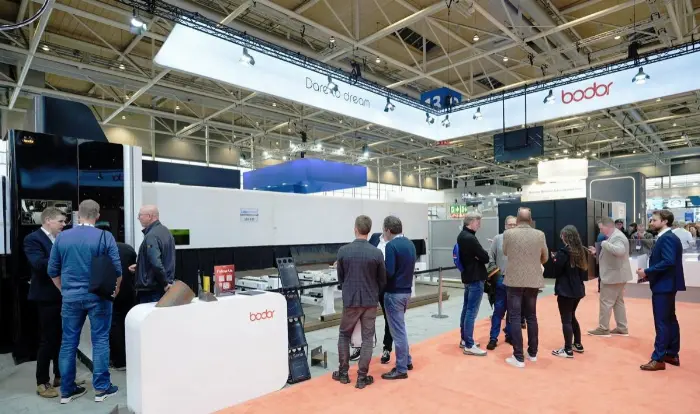
Bodor Laser Unveils New Tube Cutters at EuroBLECH 2026
The Small Delays That Eat a Tube Shop’s Day
Anyone who runs a tube cutting line knows the frustration. A short tube needs loading, the machine has to re-home, and a heavy section slows everything down while the next job waits.
None of these delays look dramatic on their own, but they add up across a shift. That is the problem Bodor Laser is aiming at with two new tube laser cutting machines shown at EuroBLECH 2026.
Where the Machines Appeared
EuroBLECH is described as the world’s leading sheet metal working trade fair, and the 2026 edition ran October 20-23 in Hannover, Germany. Bodor Laser exhibited in Hall 13, Booths A181 and A182, across more than 1,400 m² of space.
According to the company’s announcement, the booth ranks among the five largest at the show. It is also the largest among Chinese exhibitors. Both new tube machines were making their European debut at the event.
The Four-Chuck Series: Built for Heavy Tubes
The first machine family uses a four-chuck design with a fully floating chuck configuration and unrestricted rotation. Bodor says that, compared with conventional three-chuck machines, its dual-process mode significantly improves efficiency on heavy tubes.
Smarter chuck logic
The system automatically matches its chuck logic to the length of the tube and the part being cut. That means operators are not manually reconfiguring the machine for every length change.
Faster loading of short tubes
The series also uses intelligent stepless retraction. Short tubes can be loaded without re-homing the machine, which Bodor says further boosts loading speed. For shops that cut many short lengths, that is the kind of detail that saves real time.
The Double-Chuck Series: Cutting, Drilling and Tapping in One Place
The second machine family is a brand new double-chuck series. It combines cutting, drilling and tapping on a single platform, with an optional 14-position tool magazine.
The idea is to cut down on workpiece transfers, repeated setups and waiting between processes. Every time a part moves to another machine, there is a chance for delay and positioning error, so keeping operations on one platform has an obvious appeal.
Real-time detection on the tube
The series pairs laser scanning, visual recognition and intelligent sensors. Together they detect tube contours, weld seams and processing conditions in real time.
Based on that data, the machine can dynamically adjust its cutting centre, which Bodor says gives greater stability. Weld seams are a good example of why this matters, since seam position on a tube can affect how a cut or hole lands.
Beyond Tubes: The Wider Bodor Lineup
Bodor also displayed its full metal fabrication portfolio, covering the path from raw material to finished part.
Sheet laser cutting
Three sheet laser cutting machines were on show: the P6 60 kW, the P3+Automation-12 kW and the i3 6 kW. The P Series delivers up to 4G acceleration and 200 m/min speed.
The automated system integrates sheet handling with storage for both raw material and finished parts. The goal is continuous production flow, with less manual material handling between jobs.
Welding
For finishing, Bodor showed a 3 kW robotic laser welder and the Pro 1.5 kW handheld laser welder. Together with the cutting machines, they complete the workflow from cutting to finishing.
Support Behind the Hardware
Buying a machine is only half the story, and service coverage matters just as much. Bodor Laser operates service centres in Germany and Hungary, with over 10 locally based professionals.
Globally, the company serves customers in 180+ countries through 20+ service centres and 500+ service locations. German-speaking technical specialists were also on site at EuroBLECH to demonstrate capabilities and discuss applications.
On market position, the announcement cites FORWARD Business Information Co., Ltd., Shenzhen. According to that firm, Bodor Laser ranked No. 1 globally in sales of 1 kW+ laser cutting machines for seven consecutive years, 2019-2025.
What to Check Before Choosing a Tube Laser
Trade show announcements describe what a manufacturer intends a machine to do. Before committing to any tube laser, run your own checks against your real work.
Start by listing your typical tube lengths and wall thicknesses, and note how often you switch between short and heavy sections. Then ask for a test cut on your own material, and ask how the machine handles weld seams. Finally, confirm where the nearest service team is based and how quickly spare parts arrive.
Frequently Asked Questions
What is the difference between the four-chuck and double-chuck series?
Based on Bodor’s announcement, the four-chuck series focuses on heavy-tube efficiency, using a floating chuck setup and automatic chuck logic. The double-chuck series focuses on combining cutting, drilling and tapping on one platform, with real-time tube detection.
Can the double-chuck series do more than cut?
Yes. It integrates cutting, drilling and tapping on a single platform, with an optional 14-position tool magazine. That reduces transfers and repeated setups between operations.
Where were the machines shown?
They were displayed at EuroBLECH 2026 in Hannover, Germany, October 20-23, in Hall 13 at Booths A181 and A182. It was the European debut for both tube machine series.
What to Watch Next
If you cut tube regularly, the useful question is where your own time is lost today. It might be loading short pieces, handling heavy sections, or moving parts between machines for drilling and tapping.
Match that bottleneck to the features above, then request a demonstration with your own tube profiles before making a decision. The right machine is the one that removes your specific delay, not the one with the longest spec sheet.