

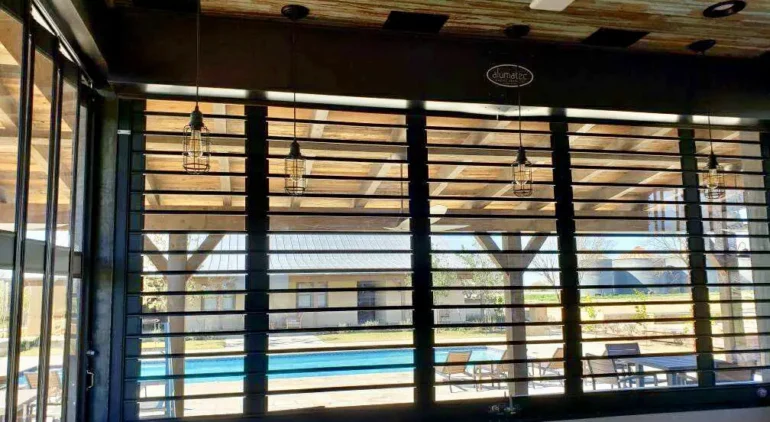
Polycarbonate Roll Up Doors in Quezon City
Polycarbonate Roll Up Doors in Quezon City: When Natural Light and Physical Security Need to Coexist
A conventional steel roll up door solves the security problem completely and the natural light problem not at all. When a shutter closes, the space behind it goes dark — a tradeoff that is acceptable for warehouse back walls and storage closets but increasingly problematic for retail storefronts, showrooms, and commercial spaces where customer visibility, interior ambiance, and energy cost all depend on natural light reaching the interior even during partial closure or after-hours periods.
Polycarbonate roll up doors address this directly. By replacing steel slats with transparent or translucent polycarbonate panels — supported and interconnected by precision-fabricated steel framing components — these systems allow natural light to pass through the curtain while the door is in the closed or partially open position, maintaining the visual connection between interior and exterior that solid steel shutters eliminate entirely.
For retail operators, showroom managers, commercial property owners, and facility operators sourcing polycarbonate roll up doors in Quezon City, understanding how these systems are engineered — and specifically why the steel framing components are as important as the polycarbonate panels themselves — is the foundation of making a specification decision that produces a reliable, long-lasting installation. Boswell Limited Co., a steel fabrication company based in Malabon since 2005, applies its CNC press brake and cutting expertise to the structural steel elements that hold polycarbonate roll up systems together and keep them operating correctly over years of daily use.
Why Polycarbonate Roll Up Doors Are Gaining Ground in Quezon City
Quezon City’s commercial landscape is one of the most diverse in Metro Manila — spanning large-format retail corridors, dense mixed-use commercial strips, institutional campuses, and light industrial zones, all with different operational requirements for their security and access systems. Several converging factors are driving polycarbonate roll up door adoption across this varied commercial environment.
Natural light transmission is the primary driver in retail and showroom applications. A storefront that remains visually accessible from the street — even when the door is in a partially or fully closed position — communicates openness and draws customer attention in a way that a blank steel shutter does not. For businesses whose merchandise benefits from being seen, this visibility translates directly into commercial value.
Energy cost reduction is a secondary but increasingly significant factor. Natural light entering through a polycarbonate door curtain during daylight hours reduces the artificial lighting load inside the space, a meaningful operational cost saving for businesses that maintain extended hours or operate in spaces where lighting infrastructure represents a substantial portion of utility expenditure.
Security without visual barrier is a combination that polycarbonate systems achieve in applications where monitoring the interior from outside — or monitoring the exterior from inside — is an operational requirement. Security-sensitive retail environments, pharmaceutical dispensaries, and office reception areas all benefit from a door that can be closed for security while maintaining sightlines in both directions.
The Steel Framing: Where System Performance Is Actually Determined
The polycarbonate panels in a polycarbonate roll up door are the component that most people look at. They are not the component that determines whether the system performs reliably over its service life. That determination happens at the steel framing level — the edge channels, end caps, hinge points, and interlocking mechanisms that hold each polycarbonate section in position, allow adjacent sections to interlock smoothly during rolling, and provide the structural framework that polycarbonate sheet alone cannot supply.
This distinction matters for a specific engineering reason. Polycarbonate expands and contracts significantly with temperature changes — more so than steel, and in Quezon City’s climate, the daily temperature swing between early morning and peak afternoon can be substantial. Steel edge channels that hold polycarbonate panels must be dimensioned to accommodate this thermal movement: tight enough to retain the panel securely and prevent rattling under wind load, but loose enough to allow the expansion differential between polycarbonate and steel without building up stress that could crack the panel or distort the frame.
Getting this dimensional relationship right requires understanding the thermal expansion coefficients of both materials, the expected temperature range of the installation, and the panel dimensions involved — and it requires fabricating the edge channels to those calculated dimensions consistently across every panel section in the curtain. Manual forming of these channels introduces exactly the kind of piece-to-piece variation that creates inconsistent thermal fit across the curtain. CNC press brake forming eliminates that variation, producing edge channels that match the design specification on every section.
Material Selection for the Steel Framing Components
While polycarbonate provides the door’s visible light-transmitting surface, the framing components that hold the system together are fabricated steel, and material selection for those components follows the same logic as Boswell’s broader structural fabrication work.
Galvanized Carbon Steel is the standard framing material for most commercial polycarbonate roll up installations in Quezon City, providing corrosion resistance appropriate for covered and semi-exposed commercial applications at a cost point that makes the system economically viable for a wide range of installation budgets.
Stainless Steel framing components are specified for installations in food service environments, pharmaceutical facilities, coastal commercial properties, and anywhere that the framing components will face regular moisture exposure, chemical cleaning, or salt-laden air that would compromise galvanized carbon steel over a reasonable service life. Stainless framing paired with polycarbonate panels produces a system that maintains both visual clarity and structural integrity in corrosive environments where a galvanized system would progressively degrade.
Aluminum framing reduces the overall system weight significantly compared to steel alternatives, which has practical implications for the barrel and operating mechanism sizing — lighter curtain weight means lower operating force requirements for manual systems and reduced motor load for powered systems. Aluminum framing is also naturally corrosion-resistant without additional surface treatment, simplifying the finish specification for outdoor or high-humidity installations.
Polycarbonate Panel Selection and Its Interaction With Framing Design
Not all polycarbonate sheeting performs identically in roll up door applications, and the panel specification interacts directly with the framing design in ways that affect both optical performance and structural behavior.
Panel thickness determines rigidity — thicker panels are stiffer within each framed section, reducing the mid-panel flex that thinner material shows under wind load when the door is closed against significant pressure differentials. Thicker panels are also heavier, which affects curtain weight and the barrel sizing required to handle the coiling load without excessive stress concentration.
Panel tint affects light transmission — clear polycarbonate maximizes light transmission but also allows full visual transparency from outside; tinted or translucent panels diffuse light while reducing direct visibility into the space, which suits applications where light transmission is desired but direct sightlines into the interior are not.
UV stabilization is a critical specification for panels in Quezon City’s sun-exposed installations. Unstabilized polycarbonate yellows and becomes brittle with UV exposure over two to three years — a visible, structural, and optical failure mode that UV-stabilized panels specifically prevent. Specifying UV-stabilized polycarbonate for any installation with direct sun exposure is not optional if service life beyond a few years is the expectation.
The framing edge channel dimensions and retention geometry are designed around the specific panel thickness specified for the project. Changing panel thickness after framing is fabricated creates a mismatch that affects both the thermal accommodation and the panel retention security of the system — which is why panel specification and framing design need to be confirmed together before production begins.
Operating Systems: Manual Versus Motorized for Quezon City Applications
Quezon City’s commercial density means that many roll up door installations face high daily cycling frequency — storefronts opening and closing multiple times per day, warehouse doors handling regular delivery traffic, and facility access points in constant use during business hours. The choice between manual and motorized operation affects both the operating mechanism specification and the structural requirements of the barrel and guide rail system.
Manual systems rely on counterbalance spring tension to offset the curtain weight, allowing the door to be raised and lowered with manageable physical effort. For polycarbonate curtains, the lighter panel weight compared to steel makes manual operation more practical at larger opening widths than equivalent steel curtain systems — a useful advantage in retail and commercial applications where power supply to the door location is limited or where motorization cost is a constraint.
Motorized systems use an electric drive unit to control opening and closing, typically with limit switches that stop the curtain at the fully open and fully closed positions. For high-cycling applications in Quezon City’s busiest commercial locations, motorization reduces physical effort and wear on the operating hardware, and allows remote or automated control of the door that manual systems cannot provide.
Boswell Limited Co.: Precision Steel Framing for Polycarbonate Roll Up Doors in Quezon City
Since 2005, Boswell has fabricated metal components across a wide range of structural and architectural applications, developing the CNC forming precision and material knowledge that polycarbonate roll up door framing specifically requires. The steel edge channels, end caps, interlocking hardware, guide rails, and barrel components that hold a polycarbonate roll up system together are not commodity parts — they are precision-fabricated structural elements that determine system performance over years of daily operation in Quezon City’s demanding commercial environment.
If your commercial, retail, or institutional property in Quezon City requires polycarbonate roll up doors engineered for reliable long-term performance, Boswell Limited Co. has the fabrication capability, material expertise, and engineering process to deliver a system built correctly from the structural components outward.
Contact Boswell Limited Co. to discuss framing specifications and panel requirements for your next polycarbonate roll up door project in Quezon City.