

Marking and Etching in Quezon City
Marking and Etching in Quezon City: Permanent Part Identification That Survives the Full Service Life of the Component
There is a fundamental difference between identification that is applied to a metal surface and identification that is part of it. A printed label, an adhesive tag, or a paint-stenciled code sits on top of the metal — subject to peeling, fading, chemical attack, and physical abrasion over the component’s service life. A laser-etched serial number, an engraved part code, or a dot-peen marked batch identifier is in the metal — altered surface structure that survives handling, cleaning, coating processes, and years of operational exposure without degrading into illegibility.
For manufacturers, equipment operators, contractors, and quality-sensitive businesses sourcing marking and etching in Quezon City and across Metro Manila, the choice of marking method directly determines whether the identification on a component remains readable and functional throughout that component’s entire service life — or becomes a maintenance problem the moment a label peels or a stenciled code wears away. Boswell Limited Co., a steel fabrication company based in Malabon since 2005, integrates precision marking and etching capability into its fabrication production line, providing permanent identification solutions across the full material range the company works with.
Why Permanent Marking Matters More Than Most Clients Initially Recognize
The need for permanent part marking often does not feel urgent until something goes wrong. A component is returned for warranty service, but the serial number label has peeled off and the unit cannot be traced to its production batch. An equipment inspection requires identification of a structural component, but the painted-on code has corroded away with the surrounding surface. A regulatory audit requires proof that components meet a specific material or production standard, but the markings that would demonstrate compliance are no longer legible.
These are real scenarios that play out across Quezon City’s manufacturing, construction, healthcare, and industrial sectors every day — and in each case, the root cause is the same: identification was applied to the component’s surface rather than incorporated into it during fabrication.
Permanent marking — laser etching, laser engraving, or mechanical dot peen marking applied during the fabrication process — eliminates this failure mode. The identification becomes part of the component’s surface geometry, surviving whatever the component itself survives. If the part is still in service after ten years, the marking is still legible after ten years.
Marking Methods Used at Boswell
Laser Etching
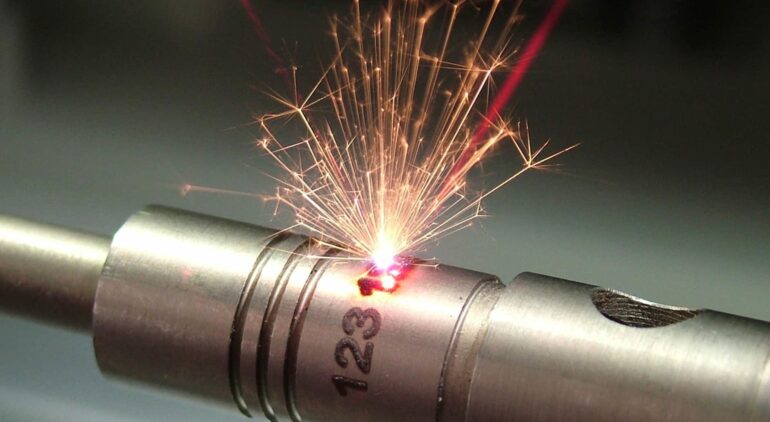
Laser etching uses a controlled beam to alter the surface finish of the metal at the marked area, creating a visible contrast through oxidation, surface texture change, or selective removal of a surface treatment layer. The process does not remove significant material depth — instead, it modifies the surface character at the marked location to create a high-contrast identifier that is visually clear under normal inspection conditions.
Laser etching is the preferred method for applications requiring fine detail — small QR codes, dense text blocks, intricate logos, and alphanumeric serial numbers at sizes that would be difficult or impossible to achieve cleanly through mechanical marking methods. The CNC-controlled laser reproduces the same mark with the same position, size, and contrast across every part in a production run, which is the critical requirement for serial number sequences, batch codes, and other traceability markers that must be consistent and sequential across large quantities.
Laser Engraving
Where etching modifies the surface, engraving removes a controlled depth of material, creating a mark with physical depth that is tactilely as well as visually distinct from the surrounding surface. This depth makes the mark more resistant to surface treatments applied after marking — powder coating, paint, or galvanizing — because the mark is recessed below the original surface plane rather than sitting at it.
Laser engraving is specified for components that will receive heavy surface treatments after marking, for identification that must remain readable in environments where surface abrasion is ongoing, and for applications where regulatory or industry standards require a permanently recessed mark that cannot be altered or obscured without visibly damaging the component.
Dot Peen Marking
Dot peen marking uses a hardened stylus driven pneumatically or electromagnetically to indent a series of dots into the metal surface, forming alphanumeric characters and barcodes from the dot pattern. This mechanical marking method is CNC-controlled for character positioning and spacing, producing marks with consistent depth and legibility across the production run.
Dot peen is particularly suited to heavier gauge material where laser access is constrained, to applications requiring very deep marks for maximum durability, and to marking operations integrated into larger production lines where the marking station needs to process high part volumes efficiently. The marks produced are permanent in the most literal sense — physically deformed metal surface that cannot be removed without grinding away the base material itself.
Material-Specific Marking Considerations for Quezon City Applications
Quezon City’s industrial and commercial base generates marking requirements across the full material range that Boswell works with, and each material behaves differently under marking processes.
Carbon Steel responds well to both laser etching and dot peen marking. Laser etching on carbon steel produces a dark oxidized mark with strong contrast against the surrounding steel surface, readable under a wide range of lighting conditions. Dot peen marking on carbon steel achieves excellent depth with standard stylus pressures, producing marks that remain legible even through moderate surface corrosion.
Stainless Steel is one of the most commonly marked materials in Quezon City’s healthcare, pharmaceutical, and food service sectors, where component traceability is a regulatory requirement and the corrosive environment makes surface-applied identification impractical. Laser etching on stainless produces high-contrast marks through selective oxidation of the surface layer, creating a dark mark on the bright stainless background without penetrating the passive oxide layer that gives the material its corrosion resistance — preserving the material’s performance characteristics at the marked location.
Aluminum requires specific laser parameter settings for clean etching results, owing to the material’s high reflectivity and thermal conductivity. Properly configured laser etching on aluminum produces clear, consistent marks across a range of alloys and tempers commonly encountered in Quezon City’s electronics, packaging, and structural fabrication sectors.
Brass and Copper present the same reflectivity challenges as aluminum and require similarly specific laser configurations to achieve clean marking results. Properly executed laser etching on brass and copper is used for product identification on electrical components, premium hardware marking, and decorative identification applications where the material’s visual character is part of the product specification.
Traceability Applications Driving Marking Demand in Quezon City
Quezon City’s diverse economy generates marking and etching requirements across a wide range of traceability and identification applications.
Electronics and electrical equipment manufacturers operating in Quezon City require serial number marking on product enclosures, PCB mounting hardware, and internal components for warranty tracking, quality control, and regulatory compliance. Healthcare facilities and medical equipment suppliers require permanent identification on equipment frames, instrument components, and institutional property items that must remain traceable through repeated cleaning, sterilization, and maintenance cycles. Construction and structural fabrication projects require heat number marking, batch codes, and specification stamps on structural steel components to demonstrate material compliance during inspection. Industrial equipment operators require part numbers and maintenance identification on machine components to support spare parts management and maintenance scheduling. Automotive and vehicle parts manufacturers require permanent marking for component traceability through assembly, warranty service, and regulatory compliance across the vehicles’ service lives.
Integrating Marking Into the Fabrication Production Sequence
Marking and etching are most effectively performed as a defined stage within the fabrication production sequence rather than as an afterthought after the component is otherwise complete. The timing of marking relative to other production steps — cutting, bending, welding, and surface finishing — determines which method is appropriate and how the marking specification needs to be designed.
Marking before surface finishing requires the mark to be deep enough or contrast-generating enough to remain legible through the finish layer. Marking after finishing requires the laser or mechanical process to work through or on top of the applied finish without compromising the finish’s protective function elsewhere on the part surface. Boswell’s production planning for marked components accounts for this sequencing, positioning the marking operation at the point in the production flow that produces the best combination of mark permanence and finish integrity for each specific application.
Boswell Limited Co.: Precision Marking and Etching Built Into the Fabrication Process
Since 2005, Boswell has operated marking and etching as a genuine fabrication capability — not a peripheral service offered as an afterthought, but a production stage integrated into the same engineering-reviewed, CNC-driven process that governs cutting, bending, and finishing. The investment in CNC marking equipment since 2015 has brought the company’s marking precision to the level that Quezon City’s quality-sensitive manufacturing and institutional sectors specifically require.
If your project requires precision marking and etching in Quezon City or anywhere across Metro Manila, Boswell Limited Co. has the equipment capability, material knowledge, and process integration to deliver permanent identification that remains legible and functional for the full service life of every component it marks.
Contact Boswell Limited Co. to discuss marking and etching specifications for your next fabrication project in Quezon City.