

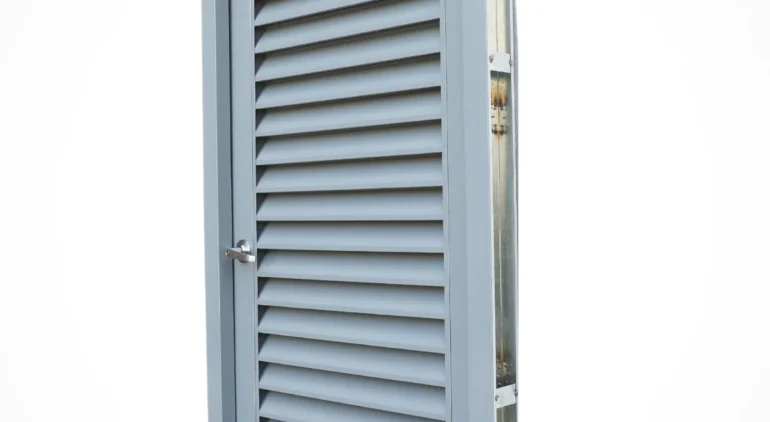
Louver Doors In Valenzuela
Louver Doors in Valenzuela: Why Ventilation Performance Depends on the Fabrication, Not Just the Design
A louver door looks straightforward on paper — a door with angled blades instead of a solid panel, built to let air pass through while still functioning as a door. In practice, the difference between a louver door that ventilates evenly and seals out wind-driven debris, and one that rattles, leaks airflow unevenly, or warps within a couple of years, comes down almost entirely to how precisely the blades were formed and mounted. The design concept is simple. The fabrication tolerance required to make that concept actually work in the field is not.
For facility managers, contractors, and equipment room operators sourcing louver doors in Valenzuela and across Metro Manila, understanding what separates a properly fabricated unit from a generic one is the difference between a door that performs reliably for its full service life and one that needs replacement or constant adjustment within a few years. Boswell Limited Co., a steel fabrication company operating out of Malabon since 2005, applies its CNC-driven forming process to louver door components with the same precision standard it uses across its broader product range.
What a Louver Door Is Actually Built From
A louver door is a structural assembly, not a single sheet of perforated metal. Each component plays a distinct role in how the finished door performs.
The Door Frame provides the structural shell into which blades are mounted, and must be fabricated square and dimensionally consistent along its full height. A frame that is even slightly out of square introduces misalignment across every blade mounted within it, since the blades take their reference position from the frame’s mounting channels.
The Louver Blades are the angled slats that allow airflow through the door while it remains closed. Blade pitch — the angle each blade is set at — determines the balance between ventilation volume and the door’s ability to block wind-driven rain, dust, or debris from passing through alongside the air.
Blade Mounting Channels or Brackets secure each blade to the frame at a consistent angle and vertical spacing. Inconsistent spacing between blades creates uneven airflow distribution across the door’s height and can leave gaps that compromise the door’s weather and debris resistance at specific points along the assembly.
Stiles and Rails form the vertical and horizontal structural members of the door itself, providing the rigidity needed to keep the door flat and properly hung on its hinges despite the open, perforated nature of the blade section.
Hinges and Hardware Mounting Points require the same reinforcement attention as any solid door, since louver doors still carry their own weight through every open-close cycle, and inadequate reinforcement at hinge points leads to sag over time just as it does with solid metal doors.
Why Blade Tolerance Is the Defining Quality Factor
A louver door typically includes a dozen or more individual blades stacked within the frame, and the functional performance of the entire door depends on every one of those blades sharing the same pitch angle and consistent spacing relative to its neighbors. A single blade set even a few degrees off from the rest creates a localized weak point — a gap where airflow behaves inconsistently, or where wind-driven rain and debris find a path through that the rest of the door’s geometry is designed to block.
This is a precision manufacturing problem, and it is exactly where CNC fabrication outperforms manual production. Once a blade profile and mounting specification is programmed, every blade produced from that program shares identical dimensions, regardless of position in the production run. Manual forming, where each blade is bent individually by an operator working from a template, introduces exactly the kind of cumulative variation that leads to uneven airflow and inconsistent weather performance across the finished door.
Boswell’s CNC press brake and cutting equipment, in place since the company’s 2015 investment in modern machinery, addresses this directly — producing blade sets that match the original engineering specification across the full quantity ordered, whether that is a handful of doors or a large multi-unit facility order.
Material Selection for Louver Doors
Material choice depends on the door’s installation environment and the mechanical demands placed on it.
Carbon Steel, typically galvanized or powder coated, is the standard material for most industrial and commercial louver door applications, offering strong structural rigidity at a reasonable cost point for equipment rooms, mechanical closets, and utility access doors.
Stainless Steel is specified where corrosion resistance is a priority, particularly in facilities with high humidity, washdown cleaning requirements, or coastal exposure where galvanized steel would eventually show surface degradation over its service life.
Aluminum is selected when reduced weight is beneficial, such as larger door sizes where minimizing overall mass eases the load on hinges, or applications where natural corrosion resistance without additional coating is preferred.
Boswell fabricates frames, blades, and hardware mounting components in all of these materials within the same integrated production line, ensuring consistent quality control across every component of the finished door rather than combining parts sourced from separate, potentially mismatched suppliers.
Common Applications for Louver Doors
Mechanical and equipment rooms rely on louver doors to provide the continuous ventilation that electrical panels, generators, and HVAC equipment require for proper cooling, while still maintaining a secure, lockable access point. Utility and storage closets in commercial and industrial buildings use louver doors where moisture control and air circulation prevent the buildup of humidity and odors in enclosed spaces. Server and telecom equipment rooms specify louver doors as part of broader passive cooling strategies, reducing reliance on active climate control while still securing sensitive equipment behind a lockable barrier. Industrial facilities use heavier-gauge steel louver doors for ventilation access points exposed to higher mechanical stress or larger opening sizes than typical commercial applications require.
In each of these cases, the door is serving a specific functional requirement — ventilation paired with security — rather than functioning primarily as an architectural or aesthetic element, which is part of why fabrication precision matters more here than in many other door categories.
Customization Based on Ventilation and Security Requirements
Not every louver door application calls for the same blade configuration. A space requiring maximum airflow with minimal weather exposure concerns can be specified with a shallower blade pitch and wider spacing, while an application with significant wind-driven rain or dust exposure benefits from a steeper pitch and tighter blade overlap, even though that configuration slightly reduces total airflow volume.
Boswell’s consultation process begins with understanding the specific ventilation requirement and environmental exposure for each project before any blade profile is programmed into the CNC equipment. This avoids the common mistake of applying a single generic louver specification across installations with meaningfully different performance requirements.
Finishing Options for Louver Doors
Powder coating provides a durable, color-customizable finish suited to commercial and industrial louver doors where appearance is a consideration alongside function. Galvanizing offers cost-effective, long-term corrosion protection for industrial applications where appearance is secondary to durability and ventilation performance. Stainless steel finishes, left brushed or polished depending on the application, are specified for environments requiring both corrosion resistance and a cleaner architectural appearance, such as food processing or pharmaceutical facility access points.
Why Fabrication Discipline Determines a Louver Door’s Real Lifespan
Two louver doors built to the same nominal specification can perform very differently in the field if one was produced with consistent CNC-formed blades and a properly squared frame, while the other relied on manual forming with operator-dependent variation between blades. The visible difference may be minor at installation, but over years of daily temperature cycling, wind exposure, and repeated door operation, the inconsistently fabricated unit develops uneven wear, blade rattle, and gradually degrading weather performance, while the precision-fabricated unit continues to function as originally specified.
Boswell Limited Co.: Louver Doors Built on Fabrication Precision
Since 2005, Boswell has approached every fabricated product, including louver doors, as an engineering problem rather than a generic production run. Supported by CNC equipment investment since 2015, the company produces blade and frame components held to consistent tolerances across every unit, ensuring the finished door performs according to its actual ventilation and durability specification, not just its nominal one.
If your project requires louver doors in Valenzuela or anywhere across Metro Manila, Boswell Limited Co. has the CNC fabrication capability and material expertise to deliver doors engineered for reliable long-term performance.
Contact Boswell Limited Co. to discuss specifications for your next louver door project.